All articles

August 8, 2026

By Sam Gao, Founder of Diningprint

Small Custom Chopstick Orders: Buy Locally or Import from China?

A low factory unit price is not the same as a low delivered cost. Use this real, anonymized 21,000-pair quotation to decide whether to buy locally or import.

  • custom chopsticks
  • small order sourcing
  • import from China
  • local supplier
  • chopstick MOQ
  • paper sleeves
  • FOB Shanghai
  • landed cost
  • restaurant purchasing
  • B2B sourcing
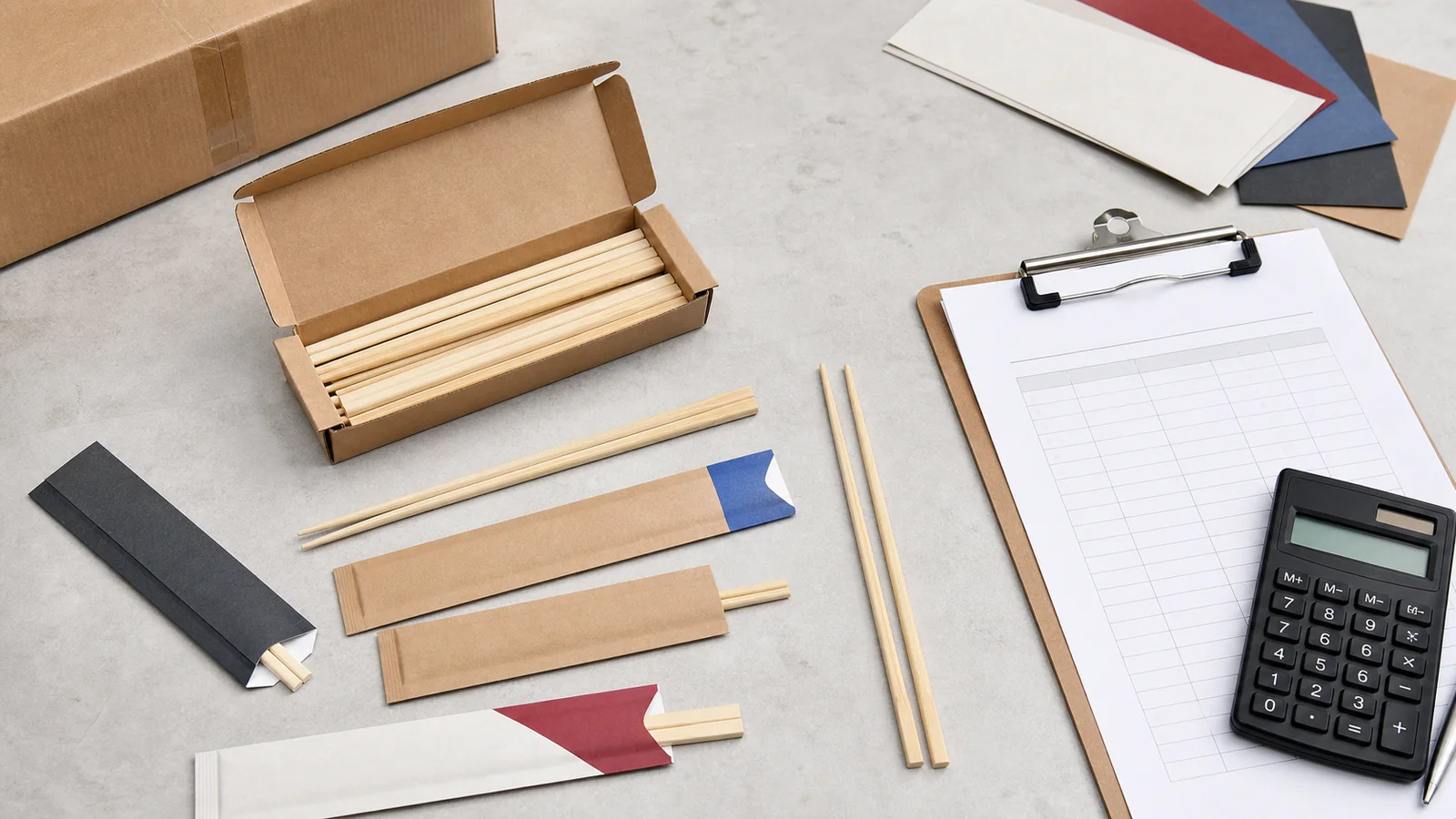
Bamboo chopsticks paper half sleeves export cartons and quote worksheet for comparing local supply with China import costs
Illustrative procurement-planning scene. Compare the complete landed route, not only the first factory unit price.

Short answer: small orders are usually a local-supply job

If you need a few cartons of chopsticks for one restaurant, a short event, or an opening month, importing a custom run from China is often the wrong first move. The factory price may look low, but a buyer still has to absorb artwork setup, samples, export packing, international freight, import charges, brokerage, and local delivery.

For a small or one-time order, buy stock chopsticks from a local foodservice distributor and ask a local printer or packaging converter to add the paper sleeve. Importing becomes more attractive when the artwork is stable, the order is repeatable, and the volume is large enough to spread fixed costs across many pairs.

Order sizePractical first routeWhy
Below 5,000 pairsBuy locallyStock products, short lead time, no import process, and easier replenishment.
5,000–20,000 pairsPrice locally firstFixed setup and freight can outweigh the factory-unit saving.
20,000–50,000 pairsCompare both routesChina can work for simple repeatable artwork; local supply can still win on urgency and delivered cost.
50,000+ pairsRequest a China production quoteSetup, export handling, and freight are spread across more units.
Repeat purchasing programModel the annual volumeA first-run plate cost may be reused, making later production runs more economical.

These are decision ranges, not universal supplier minimums. The correct route depends on the sleeve, color count, carton packing, destination, deadline, and whether the artwork will be reordered.

A real 21,000-pair quotation: the factory number is not the landed number

In July 2026, Diningprint prepared an anonymized first-order quotation for a European sushi restaurant operator. The buyer asked for 21,000 pairs of 210 mm knotless bamboo tensogue chopsticks in a half sleeve / open paper band. The original reference artwork appeared to use up to eight colors. For the production quotation, the sleeve was costed as a four-color design.

Quote lineQuantityRMBUSD at quote date
One export carton3,000 pairs¥500US$73.87
Product and packing total7 cartons / 21,000 pairs¥3,500US$517.09
First-order artwork setup4 colors × ¥100¥400US$59.09
First-order export-side total21,000 pairs¥3,900US$576.17

The quoted product cost was about US$0.0246 per pair. Including the first-order artwork setup, the export-side total was about US$0.0274 per pair. That number is useful, but it is not a delivered-to-restaurant price.

What that quotation included

  • Knotless bamboo tensogue chopsticks
  • Custom paper half sleeves
  • Inner plastic bags and export cartons
  • Processing, export declaration, and inspection
  • Delivery to Shanghai Port

What the buyer still had to add

  • International freight or courier charges
  • Destination customs clearance, tax, or duty
  • Broker, terminal, or handling charges where applicable
  • Delivery from the destination port to the restaurant
  • Any physical printed-sample cost not listed in the production table

This is why buyers should compare landed cost, not the first unit price in an email. A local quote may look higher per pair and still cost less after the complete route is counted.

Why eight colors can be expensive on a small half sleeve

Color count is a fixed-cost problem. A spot-color design normally needs a separate printing plate for each color. The cost does not fall because the buyer orders fewer pairs, so each extra plate has a larger effect on a small run.

There is an important production distinction: an artwork file that visually contains many colors is not always printed as eight separate spot colors. A printer may rebuild it as four-color CMYK, use selected spot colors, or recommend a simpler one- or two-color treatment. The plate count should be confirmed from the production-ready file, not guessed from a JPEG logo.

For the case above, simplifying the original request to a four-color quotation kept the first-order setup at ¥400. The better commercial question was not "Can the factory print eight colors?" It was "Will eight colors improve a narrow disposable sleeve enough to justify the setup and proofing risk?" For many independent restaurants, the answer is no.

When a local supplier is the better decision

Choose a local distributor or converter when most of these statements are true:

  • You need fewer than 20,000 pairs.
  • The restaurant opens soon and cannot absorb international lead time.
  • The logo, menu, location, or brand colors may still change.
  • You need several artwork versions in small quantities.
  • You do not have an importer, customs broker, or consolidated freight route.
  • You want to test whether guests actually notice or use the branded sleeve.

A sensible local route is to buy standard chopsticks by the carton and print the sleeve locally. The chopstick stays a stock item, while the visible brand surface can be changed without waiting for another international production run.

When importing from China starts to make sense

A direct production quote becomes more useful when the order is not merely large, but repeatable:

  • The buyer can place at least 20,000–50,000 pairs in one approved artwork.
  • The sleeve design will be reused for later orders.
  • The restaurant group can consolidate several locations into one SKU.
  • The specification includes a particular chopstick shape, wood grade, paper, or packing format that local stock does not offer.
  • The buyer can plan production, freight, customs, and replenishment before stock runs out.

For restaurant groups, distributors, and repeat wholesale programs, the first plate fee is a setup investment rather than a recurring surprise. For a single venue trying one design once, it is simply another fixed cost.

Use one worksheet to compare local and import quotes

Ask both suppliers to quote the same specification, then put every cost on one line:

Landed cost per pair = product + artwork/setup + sample + export packing + international freight + import charges + local delivery, divided by the usable quantity received.

Also compare the non-price terms: payment timing, replacement policy, proof approval, carton count, delivery date, and the cost of being wrong. A local order that can be replaced next week may be safer than a cheaper import order that cannot be corrected before opening day.

What to send when requesting a 20,000+ pair quotation

  1. Chopstick specification: shape, material, length, and whether knotless appearance matters.
  2. Sleeve format: full sleeve or half/open band, with dimensions or a dieline.
  3. Production artwork: vector file where possible, not only a screenshot.
  4. Color method: CMYK, Pantone spot colors, or a request for the supplier to recommend the economical route.
  5. Quantity and reorder plan: first order plus expected annual volume.
  6. Destination and trade term: port, country, preferred Incoterm, and whether you need a delivered estimate.
  7. Deadline: opening date or stockout date, including sample approval time.

If your project is below the production MOQ, Diningprint will not disguise it as a factory production order. Use a material or printed sample for evaluation, then buy locally until the repeat volume supports a production run. For qualifying programs, see the custom chopstick MOQ guide, compare printing methods and plate economics, or prepare the sleeve with the dieline and artwork reference.

The honest buying rule

Do not import from China merely because the quoted unit price is lower. Import when the specification, repeat volume, and supply plan justify the route. For a small one-off order, a local supplier is usually the more practical partner. For a stable 20,000+ pair custom program, request a production quote and compare it against a local delivered quote before committing.

Case note: figures above come from an anonymized Diningprint quotation issued in July 2026. Customer identity and artwork are withheld. The quote was prepared for one specification and exchange rate; it is not a current public offer or a promise that another project will receive the same price. Final cost depends on artwork, plate count, product, paper, packing, destination, freight, tax, and order timing.

Frequently asked questions

Quick answers from buyers like you

Is 20,000 pairs too small to import custom chopsticks from China?

Not automatically. Around 20,000 pairs is a comparison zone: China can work for simple, repeatable artwork and planned freight, while a local supplier can be better for urgent, one-time, or frequently changing orders. Compare the complete landed cost and replacement risk rather than unit price alone.

How much did the anonymized 21,000-pair order cost?

The July 2026 quotation listed RMB 3,500 for 21,000 pairs of knotless bamboo tensogue chopsticks with paper half sleeves and export packing, plus RMB 400 for four-color first-order artwork setup. The export-side total was RMB 3,900, approximately US$576 at the quoted exchange rate. International freight and destination costs were separate.

Does an FOB Shanghai chopstick price include delivery to my restaurant?

No. An FOB or export-side price may include production, export packing, declaration, inspection, and delivery to the named China port. The buyer still needs to account for international freight, destination clearance, taxes or duties, handling, and local delivery. Confirm the exact Incoterm and inclusions in writing.

Should a small restaurant use eight colors on a chopstick sleeve?

Usually not without a production-artwork review. Multiple spot colors can require multiple plates, while some artwork can be rebuilt in four-color CMYK. On a narrow half sleeve, one or two strong colors are often clearer and more economical. Ask the printer to confirm the actual plate count from the vector file.

What should I do if my order is below the production MOQ?

Buy standard chopsticks from a local foodservice supplier and, if needed, print the sleeve locally. A factory sample can validate material and artwork, but it is not a substitute for a production order at the applicable MOQ.

Read next

Keep going on related sourcing topics.

Guide

Custom Chopstick MOQ Explained: How Much Should You Order for Your First Run?

Real entry MOQ is 20,000 pairs. Below that, Diningprint offers a free material sample or a $49 printed kit, not a production run. Here's how to plan the first PO.

Read article

Guide

Hot Stamp vs Offset vs Digital: Custom Chopstick Printing Methods Compared

Hot stamp for premium foil logos. Offset for high-volume full-color sleeves. Digital for proofing and variable artwork. Here's the cost, MOQ, and decision framework for each.

Read article

Guide

Custom Printed Chopstick Sleeves — Complete B2B Buyer's Guide (2026)

Paper grade, print method, MOQ tier, ink food-safety — and the FSC gap nobody talks about. The complete 2026 buyer's guide to custom printed chopstick sleeves, with real factory specs and PO clauses.

Read article

Guide

Chopstick Sleeve Dieline Templates: Sizes, Bleed & File Specs (Free Reference)

Everything you need to prepare print-ready artwork for custom chopstick sleeves — standard dieline sizes, bleed and safe-zone rules, color and paper options, and what to include when requesting a quote.

Read article

Guide

Custom Chopstick Sleeves for Sushi Restaurants: MOQ, Dielines & Branding

For sushi operators, the chopstick sleeve is one of the few branded items every guest touches. Here's how to spec the sleeve, choose the format, prepare artwork, and avoid vague sustainability claims.

Read article

For your industry

Custom printed chopsticks and sushi restaurant supplies for wholesale orders.

Start with the items every sushi customer actually touches: bamboo chopsticks, printed chopstick sleeves, napkins, sauce cups, paper bags, and simple takeaway boxes or trays when needed. The tableware does not need to be complicated; the goal is a clean sushi experience with one consistent brand impression.

See guide

For your industry

Custom chopsticks and branded tableware for Chinese restaurants.

Branded chopsticks, printed paper sleeves, napkins, and biodegradable cutlery kits for Chinese restaurants, hot pot, dim sum, noodle shops, banquets, and Asian catering. Build a takeout-ready kit with chopsticks, spoon, napkin, toothpick, and custom wrapper.

See guide

For your industry

Biodegradable cutlery kits and custom tableware for event catering.

Custom wooden cutlery kits, branded chopsticks, and printed napkins for event catering, weddings, festivals, stadium foodservice, and corporate dinners. A 3-piece wooden kit (fork + spoon + knife + napkin in a custom sleeve) starts at a 20,000-kit production MOQ and is priced on request. Lead time is 25-30 days plus freight.

See guide