DPDiningprint
All articles

May 25, 2026

Hot Stamp vs Offset vs Digital: Custom Chopstick Printing Methods Compared

Hot stamp for premium foil logos. Offset for high-volume full-color sleeves. Digital for small runs and variable artwork. Here's the cost, MOQ, and decision framework for each.

  • chopsticks
  • printing
  • hot stamp
  • offset
  • digital
  • packaging
  • B2B

TL;DR (the short version)

Three printing methods dominate custom chopstick production in 2026:

  • Hot stamp (foil) — metallic gold/silver/copper logos pressed directly onto the wood. Best for premium sushi, hotel, and gift packaging. Adds $0.003–$0.006 per pair.
  • Offset printing — full-color CMYK on paper sleeves. The workhorse for restaurant chains, ghost kitchens, and event caterers. Adds $0.002–$0.005 per pair.
  • Digital printing — short-run variable artwork on sleeves. Ideal for limited editions, seasonal menus, or sub-5,000-pair samples. Adds $0.008–$0.015 per pair.

If you only remember one rule: offset for volume, hot stamp for premium, digital for small or changing runs. Everything else in this guide is detail.


Why the printing method matters more than the logo design

Most restaurant owners spend weeks polishing the logo and ten minutes picking a print method — then wonder why the first 50,000 chopsticks look nothing like the digital mockup.

Here is what actually happens at the factory: a beautiful gradient that renders perfectly in Figma can dot-band into mush on a coated paper sleeve if it is printed offset at 175 lpi. A crisp metallic gold logo that wins design awards can come out as a brown smear if pressed at the wrong temperature into bamboo with too much moisture. A clever variable-color campaign — "every chopstick has a different illustration" — will blow your budget if you send it to an offset line that needs new plates for each variant.

The method dictates what your logo can look like, how much it will cost, and how long it will survive in warehouse storage and transit. Pick the wrong one and you ship something that does not match the brand you spent years building.


Method 1: Hot stamp (foil stamping)

Hot stamping is the oldest of the three methods and still the most luxurious-looking. A heated metal die presses a thin foil film — gold, silver, copper, holographic, or pigmented — onto the chopstick body itself, transferring the design through heat and pressure.

What it looks like

Foil sits on top of the wood with a slight relief and a mirror finish. Light catches it from across a dim sushi bar in a way no printed ink can match. This is why nine out of ten high-end Japanese restaurants worldwide use hot-stamped chopsticks even when offset would be cheaper.

Cost and minimums

ItemCost
One-time die (mold) cost$80–$250 per design
Per-pair foil charge$0.003–$0.006
MOQ for hot stamp50,000 pairs (some factories accept 30,000)
Lead time addition+3–5 days for die production

The die is a sunk cost the first time and a free reuse on repeat orders — one reason hot-stamp customers tend to be very sticky.

When hot stamp is the right call

  • Premium sushi, omakase, kaiseki — foil reinforces the price point
  • Hotel in-room dining — matches gold-foil menu cards and key cards
  • Luxury food gifting — Mid-Autumn, Lunar New Year, corporate hampers
  • Logos with fine line work and serif typography — foil holds detail down to ~0.3 mm

When hot stamp is the wrong call

  • Full-color photographic logos — foil is one color per die
  • Tight budgets under $0.012 per finished pair
  • Quick turnarounds under 25 days
  • Designs that depend on gradients or screen tints

Method 2: Offset printing (on paper sleeves)

Offset is the workhorse of every commercial print shop on earth, and chopstick sleeves are no exception. Ink is transferred from a metal plate to a rubber blanket and then onto the paper sleeve at high speed, with separate plates for each color (CMYK + spot Pantones if needed).

What it looks like

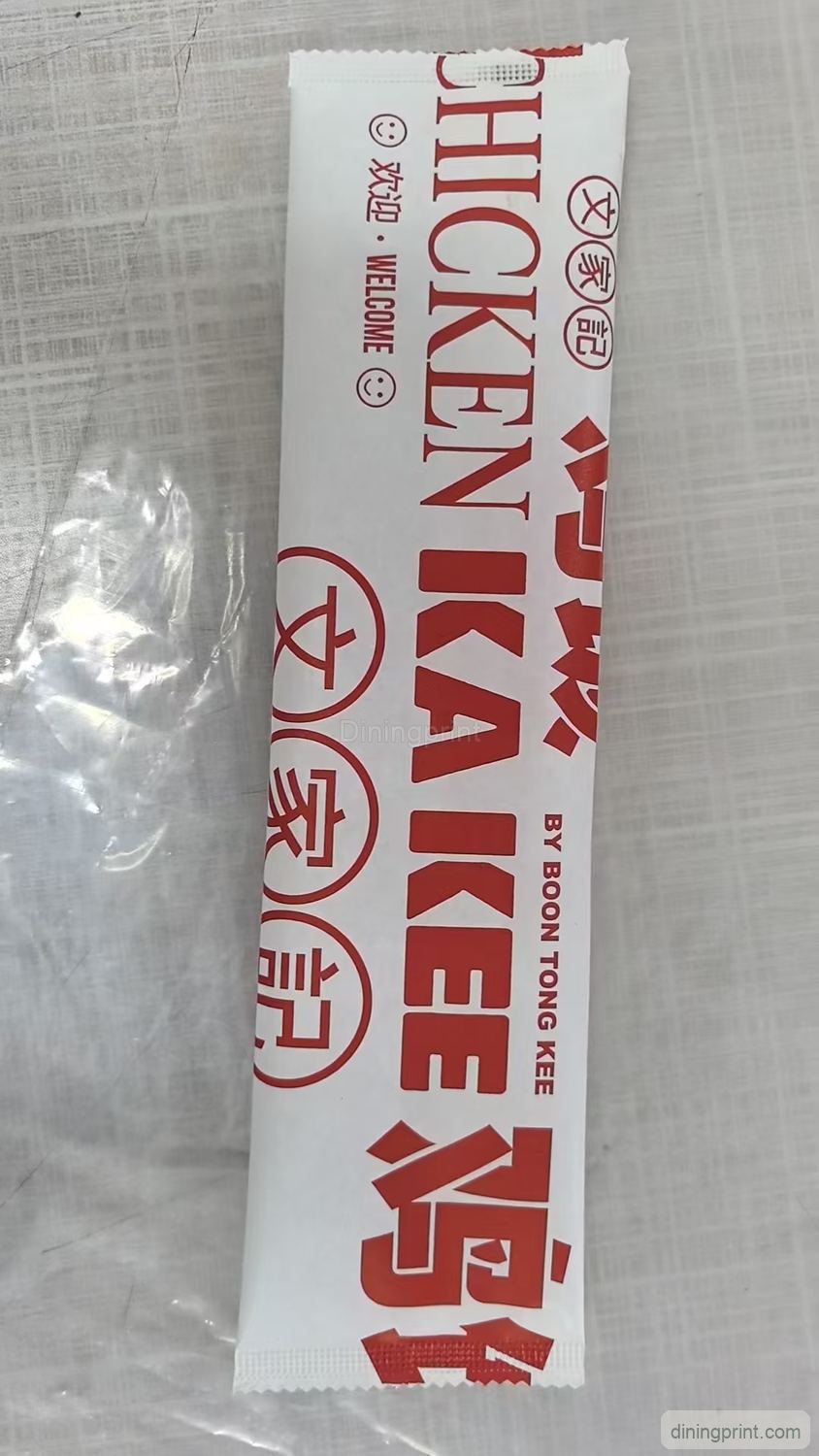
Crisp, saturated, full-color photography or vector artwork on the entire paper sleeve. This is the method behind every chain-restaurant chopstick you have ever seen — from sushi conveyor belts to ramen pop-ups to delivery-only ghost kitchens. The print quality at production volume is genuinely better than what a desktop laser printer can produce.

Cost and minimums

ItemCost
One-time plate cost$120–$300 per design (4 plates for CMYK)
Per-sleeve offset charge$0.002–$0.005
MOQ for full-color offset100,000 pairs (sleeves)
MOQ for 1- or 2-color offset50,000 pairs
Lead time addition+5–7 days for plates and color matching

Plate cost amortizes fast. At 100,000 pairs, a $240 plate cost adds only $0.0024 per pair. At 500,000, it disappears almost entirely.

When offset is the right call

  • Any order over 50,000 pairs with full-color or 2-color artwork
  • Restaurant chains, ghost kitchens, delivery brands
  • Wedding and event catering with photographic sleeves
  • Co-branded promotional campaigns (logo + sponsor + QR code)
  • Anywhere print durability matters — offset ink on coated paper survives 12+ months of warehouse storage without fade

When offset is the wrong call

  • Runs under 50,000 sleeves — plate cost dominates per-unit price
  • Variable artwork — every variation needs new plates
  • Direct printing on the chopstick body (offset is a paper method only)
  • Metallic effects — offset can simulate metallics but never match real foil

Method 3: Digital printing (on paper sleeves)

Digital is the newest of the three and the only one that bypasses plates entirely. Artwork goes straight from a PDF to a high-resolution inkjet or toner press, the same way an office printer works — just industrial-grade.

What it looks like

Visually almost identical to offset at normal viewing distance. Under a loupe, you can sometimes see a finer dot pattern. The real difference is not appearance — it is economic flexibility. Every sleeve can have different artwork at zero additional plate cost.

Cost and minimums

ItemCost
Plate / setup cost$0 (no plates)
Per-sleeve digital charge$0.008–$0.015
MOQ for digital500–5,000 pairs (factory-dependent)
Lead time addition+1–3 days only

Digital flips the math: high per-unit cost, but zero setup. The crossover with offset usually sits around 20,000–30,000 pairs. Below that, digital is cheaper. Above that, offset wins.

When digital is the right call

  • Pre-launch samples — 500 pairs to test the market before a 100K commitment
  • Seasonal menus — 5,000 pairs of Christmas-themed sleeves for a single December
  • Wedding and one-off events — couple's names and date, single-use
  • Limited-edition collaborations — artist series, charity tie-ins
  • Variable-data campaigns — every sleeve has a different QR code or message

When digital is the wrong call

  • Volume over 30,000 sleeves — offset is dramatically cheaper
  • Metallic or specialty inks — most digital presses are CMYK only
  • Pantone-critical brand colors — digital simulates Pantones less accurately than offset

Side-by-side comparison

Hot StampOffsetDigital
Printed onChopstick bodyPaper sleevePaper sleeve
Color range1 foil per dieCMYK + PantonesCMYK only
Setup cost$80–$250 (die)$120–$300 (plates)$0
Per-pair cost$0.003–$0.006$0.002–$0.005$0.008–$0.015
MOQ30,000–50,00050,000–100,000500–5,000
Lead time addition+3–5 days+5–7 days+1–3 days
Premium look★★★★★★★★★★★★
Print durability★★★★★★★★★★★★
Variable artworkNoNoYes

The decision in 30 seconds

Skip the comparison table and answer three questions:

  1. How many pairs? Under 10,000 → digital. Over 50,000 → offset or hot stamp.
  2. Where does the logo go? On the chopstick wood itself → hot stamp. On the paper sleeve → offset or digital.
  3. What's the brand vibe? Premium/luxury/Japanese fine dining → hot stamp. Modern, photographic, full-color → offset. Quick, changing, or experimental → digital.

Five mistakes restaurant buyers make on print specs

  1. Approving digital proofs without a physical sample. A PDF mockup never shows how ink behaves on coated paper or how foil reads on bamboo. Always pay the $30–$80 for a real-material sample before a 100K production run.
  2. Sending RGB artwork to an offset job. Offset is CMYK. Vivid blues and greens that look gorgeous on screen often shift muddy when converted. A good factory will flag this; a fast one will silently convert and ship the wrong color.
  3. Picking digital for "flexibility" on a 200,000-pair order. The per-pair premium — about $0.006 over offset — quietly costs $1,200 on that single PO. Multiply across the year.
  4. Specifying foil on rough or moist wood. Hot stamp needs a smooth, dry surface. Some aspen and rough-finish bamboo will not hold foil cleanly. Confirm the wood grade with the supplier before locking in the design.
  5. Forgetting about plate amortization. A $240 plate cost on 50,000 sleeves is $0.005 per pair. On 500,000 it is $0.0005. If you reorder the same artwork annually, the plate is a one-time investment, not a recurring cost — price it accordingly.

About Diningprint

Diningprint is a custom disposable tableware supplier with in-house hot stamp, offset, and digital printing at our Dalian factory (Tenglong Wood Products Co., Ltd., est. 2000). We ship to 60+ countries with FSC, FDA, BSCI, SGS, and BRC certifications.

Not sure which method fits your project? Try our chopstick customizer to preview your logo on real product photography, or request a sample kit to compare hot stamp, offset, and digital outputs side by side.

Last updated: May 2026. Pricing and minimums are indicative and vary by factory, wood grade, and season. Contact Diningprint for a quote specific to your project.

Frequently asked questions

Quick answers from buyers like you

What is the difference between hot stamping and offset printing on chopsticks?

Hot stamping presses a metallic foil (gold, silver, copper) directly onto the wooden chopstick body using a heated die. Offset printing transfers CMYK ink from metal plates onto the paper sleeve that wraps the chopsticks. Hot stamp gives a premium reflective look in one foil color; offset gives full-color photographic artwork on the sleeve. They are often used together on the same product.

How much does hot stamp printing add to the cost of custom chopsticks?

Hot stamp adds approximately $0.003–$0.006 per pair, plus a one-time die cost of $80–$250 per design. Minimum order for hot stamping is usually 30,000–50,000 pairs.

What is the minimum order for offset-printed chopstick sleeves?

Offset printing typically starts at 50,000 sleeves for 1- or 2-color artwork and 100,000 sleeves for full-color CMYK. Plate setup costs $120–$300 per design and amortizes quickly at higher volumes.

Is digital printing on chopsticks worth it for small orders?

Yes. Digital printing requires no plates and accepts orders from 500–5,000 pairs, making it the only viable method for samples, seasonal menus, wedding favors, and limited editions. Per-pair cost is higher ($0.008–$0.015) but total project cost is far lower than offset for runs under about 20,000 pairs.

At what order quantity does offset become cheaper than digital?

The crossover point is usually between 20,000 and 30,000 pairs. Below that, digital's zero-plate-cost advantage wins. Above it, offset's lower per-pair charge dominates and the plate cost is fully amortized.

Can you combine hot stamp and offset printing on the same chopstick product?

Yes, and it is common at the premium end. A typical setup is hot-stamped gold logo on the chopstick body plus offset-printed full-color artwork on the paper sleeve. Hotels, omakase restaurants, and luxury gifting brands frequently use this combination to maximize visual impact.

Which printing method is most durable for long warehouse storage?

Hot stamp foil is the most durable — it bonds physically to the wood and remains crisp for years. Offset ink on coated paper sleeves survives 12+ months without noticeable fade. Digital prints are slightly less fade-resistant but acceptable for any order shipped and used within 6 months of production.

Why do my Pantone brand colors look different on the printed sleeves than my brand guide?

Offset reproduces Pantones accurately when you specify the Pantone number and request spot-color printing, but four-color CMYK simulation of Pantones is approximate — vivid blues, greens, and oranges can shift noticeably. Digital is even less Pantone-accurate. If color fidelity is critical, ask your supplier for an offset run with a true Pantone spot color rather than a CMYK build.

Read next

Keep going on related sourcing topics.

Guide

How to Choose a Custom Chopstick Supplier: 2026 Restaurant Owner's Guide

MOQ, real unit costs, lead times, FSC compliance, and the 10 questions every restaurant buyer should ask a chopstick factory before signing a PO.

Read article

Guide

Custom Chopstick MOQ Explained: How Much Should You Order for Your First Run?

Real entry MOQ is 20,000 pairs. Below that, you have a free sample, a $49 printed kit, and a 1,000–5,000 pc paid trial path. Here's how to pick the right one for your first order.

Read article

Guide

Bamboo vs Birchwood vs Aspen: Which Chopstick Wood Is Right for Your Restaurant?

Bamboo is best for 80% of restaurants. Birchwood is the sushi-grade premium choice. Aspen is the budget option that fades fast. Here's exactly how each wood performs on strength, print, cost, and sustainability.

Read article

For your industry

Custom-printed chopsticks for sushi restaurants.

Birchwood tensogue, branded paper sleeves, and printed napkins that match the precision of your menu. From 5-location sushi bars in Berlin to 200-store franchise chains in Tokyo — we've packed millions of pairs.

See guide

For your industry

Custom chopsticks & disposable tableware for event catering.

Branded chopsticks for 200-guest weddings, wooden cutlery sets for 5,000-person festivals, custom-printed napkins for corporate dinners. Volume discounts and flexible lead times for one-off events.

See guide

For your industry

Branded takeout packaging for ghost kitchens.

When the only contact your customer has with your brand is the packaging that arrives at their door, the chopstick sleeve and cutlery wrapper carry the entire experience. Built for delivery-first restaurant brands.

See guide