DPDiningprint
All articles

May 22, 2026

Bamboo vs Birchwood vs Aspen: Which Chopstick Wood Is Right for Your Restaurant?

Bamboo is best for 80% of restaurants. Birchwood is the sushi-grade premium choice. Aspen is the budget option that fades fast. Here's exactly how each wood performs on strength, print, cost, and sustainability.

  • chopsticks
  • bamboo
  • birchwood
  • aspen
  • sustainability
  • restaurant supply
  • material guide

TL;DR (the short version)

  • Bamboo — the best all-rounder. Strong, eco-friendly, regrows in 3–5 years, mid-priced. Right for 80% of restaurants.
  • Birchwood — the premium pick. Smooth, blonde, no smell, no taste. The wood behind authentic Japanese tensogue chopsticks. Right for sushi bars, omakase, fine dining.
  • Aspen — the budget choice. Cheapest and lightest in color, but weaker and prone to fading print. Right for high-volume takeout where cost beats brand.

Most restaurants choosing custom chopsticks for the first time should default to bamboo. Upgrade to birchwood only if you serve premium Japanese cuisine. Drop to aspen only if margin pressure is severe.


Why the chopstick wood you pick matters more than you think

A pair of disposable chopsticks costs less than two cents. Yet the wood you choose quietly shapes the customer experience, your printing quality, and your supply chain — for years.

The customer holds one pair for an entire meal. If the wood splinters, your brand splinters with it. If the print fades, your logo looks tired by the time the takeout bag reaches their home. If the smell is wrong, the meal tastes wrong.

So before signing a PO, it’s worth understanding what each wood actually is — not just what the supplier’s catalog says it is.

This guide breaks down the three woods used in 95% of disposable chopsticks worldwide: bamboo, birchwood, and aspen. We’ll cover what they are, how they print, what they cost, and which restaurants each is right for.

For broader sourcing and supplier-vetting guidance, see our companion article on how to choose a custom chopstick supplier.


Bamboo chopsticks — the workhorse

What it actually is

Bamboo isn’t technically a wood — it’s a grass. The fastest-growing plant on the planet, bamboo reaches harvest maturity in 3 to 5 years, compared to 20–60 years for most hardwood trees. This is why FSC bamboo chopsticks have the lowest land-use footprint of any disposable chopstick on the market.

The bamboo most factories use for chopsticks is Phyllostachys edulis, also known as moso bamboo, grown across China, Japan, and parts of Southeast Asia.

How it performs

  • Strength: Excellent. Bamboo has a tensile strength comparable to steel by weight, which translates to chopsticks that rarely splinter or snap.
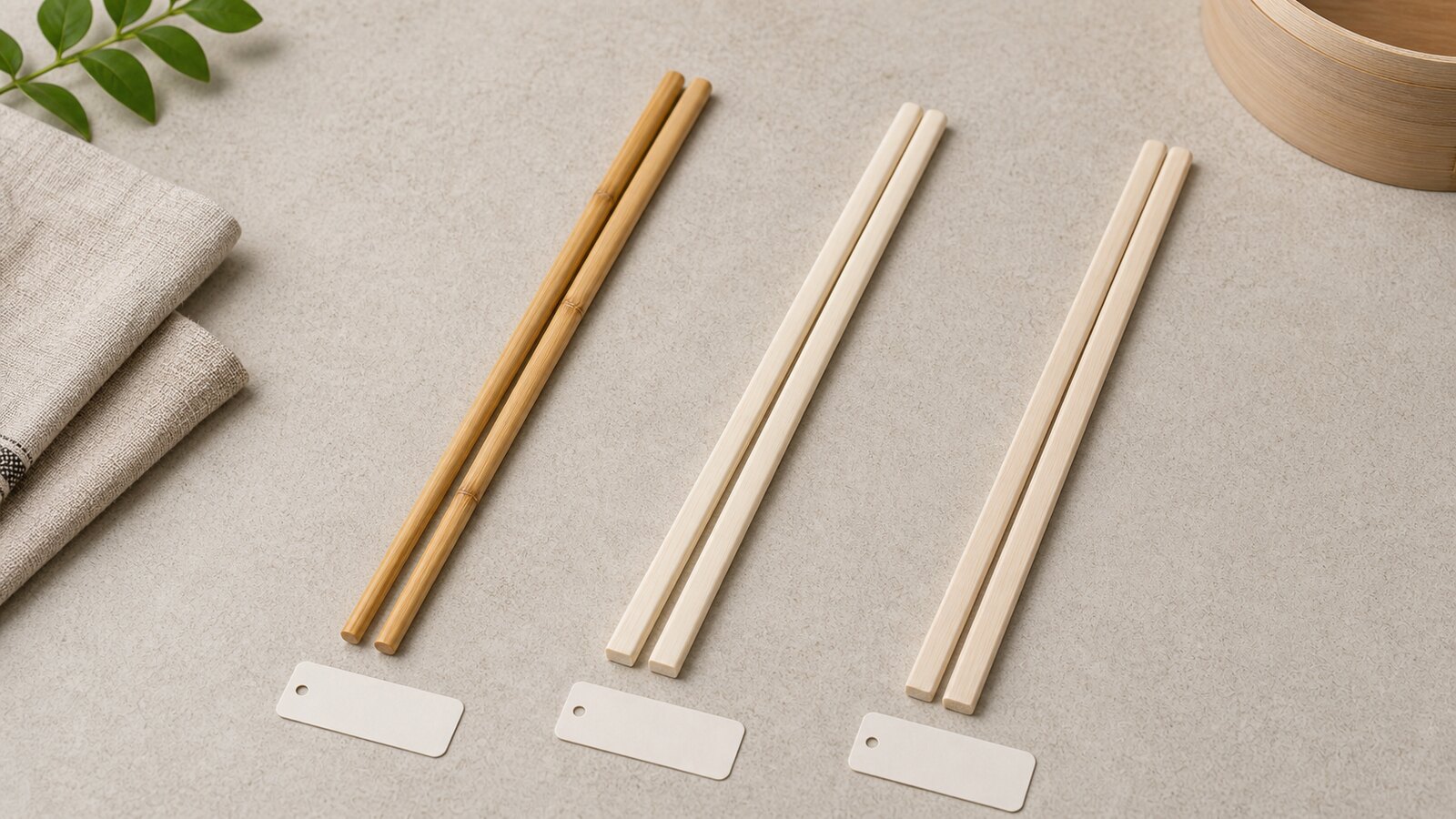
  • Color & finish: Natural light tan, slightly darker than birchwood. Surface texture is fine but not glassy.
  • Taste & smell: Mostly neutral. About 5–10% of bamboo lots have a faint “green” or grassy aroma if the curing process was rushed. Reputable factories cure for 30+ days to eliminate this.
  • Print quality: Good. The slightly absorbent surface holds 1–3 color logo prints cleanly for the life of the product.

Cost

$0.008 – $0.015 per pair for standard bamboo with paper sleeve. Add roughly $0.001–$0.003 per pair for FSC-certified material, increasingly required for EU and Australian buyers.

Best for

Sushi bars, ramen shops, casual dining, ghost kitchens, hotel buffets, catering, takeout chains. If your restaurant doesn’t fit one of the more specialized categories below, bamboo is the right default.


Birchwood chopsticks — the premium choice

What it actually is

Birchwood is a cold-climate hardwood (Betula spp.) grown across Northern China, Russia, Northern Europe, and Canada. The slow growth in cold climates produces a tight, even grain that machines beautifully.

Birch is the traditional wood for high-end Japanese tensogue chopsticks — the type sold in premium sushi restaurants and packaged in elegant paper wrappers with branded woodburn or hot-stamp printing.

How it performs

  • Strength: Highest of the three. Birchwood resists splintering even under aggressive use.
  • Color & finish: Light blonde, almost cream. Polished surfaces have a subtle glassy sheen that immediately reads as “premium.”
  • Taste & smell: Completely neutral. No flavor transfer, no aroma. This is why omakase chefs insist on birchwood — nothing competes with the sushi.
  • Print quality: Best. The smooth tight surface produces the sharpest printed logos, especially for fine detail or full-color wrappers.

Cost

$0.015 – $0.025 per pair, sometimes higher for premium tensogue grades with hand-finished tips. Generally 1.5–2x more expensive than bamboo.

Best for

Authentic Japanese restaurants, omakase, premium sushi, high-end hotel dining, luxury catering, gift packaging, and any brand where the chopstick experience is part of the perceived value.


Aspen chopsticks — the budget option

What it actually is

Aspen (Populus tremula) is a fast-growing softwood common across China and North America. It’s pale, lightweight, and inexpensive — the workhorse of the disposable chopstick industry for restaurants competing on price.

How it performs

  • Strength: Lowest of the three. Aspen chopsticks have higher splinter rates and can snap under pressure (lifting heavy noodle bundles, for instance).
  • Color & finish: The whitest of the three. The pale, almost paper-like surface offers the highest print contrast — logos look striking on day one.
  • Taste & smell: Slightly more noticeable than bamboo or birch, especially if not fully kiln-dried.
  • Print quality: Looks great when fresh, but the soft surface causes prints to fade faster over months of warehouse storage.

Cost

$0.005 – $0.010 per pair. About 30–40% cheaper than bamboo, 50–60% cheaper than birchwood.

Best for

High-volume takeout chains, ghost kitchens with thin margins, school cafeterias, event catering for one-time use, and any context where each chopstick is used once within weeks of receipt (so print fade isn’t an issue).


Quick comparison table

AttributeBambooBirchwoodAspen
Cost per pair (USD)$0.008–$0.015$0.015–$0.025$0.005–$0.010
StrengthHighHighestLow
Surface finishSmoothPremium / GlassyRough
ColorLight tanLight blonde / CreamWhite / Pale
SmellMostly neutralCompletely neutralSlightly woody
Print clarityGoodBestSharp day 1, fades over months
Splinter resistanceStrongStrongestWeak
Renewable / SustainabilityBest (3–5 yr regrowth)Good with FSCModerate
Typical MOQ50,000 pairs100,000 pairs50,000 pairs
Best fitAll-purposePremium / SushiBudget takeout

The sustainability question (and why it’s no longer optional)

Five years ago, sustainability was a nice-to-have. In 2026, for serious B2B chopstick orders, it’s a procurement gate.

FSC certification status

  • Bamboo: Widely FSC-certified. Most established factories carry FSC chain-of-custody documentation for bamboo lots.
  • Birchwood: Increasingly FSC-certified, especially Russian and Northern European sources. Verify with the supplier.
  • Aspen: FSC availability is patchier; some aspen comes from less regulated sources. Always ask for documentation.

Carbon & land-use footprint

Bamboo has the lowest per-pair footprint of the three. It regrows from rhizome — no replanting needed — and harvest cycles are 3–5 years. Birchwood and aspen require 20–40 year replanting cycles, though both species sequester more carbon per tree.

Buyer expectations by region

  • EU buyers: Most now require FSC certification. UK and Germany are strictest.
  • Australia & New Zealand: FSC effectively mandatory for retail sales.
  • US: No federal requirement, but ESG-driven brands (chains, hotels) increasingly demand FSC.
  • Middle East & LATAM: Cert is a plus but not a deal-breaker yet.

How to choose: a 30-second decision framework

Answer one question to narrow down your wood:

What does your restaurant compete on?

  • Experience / atmosphere / authenticity (omakase, kaiseki, premium sushi) → Birchwood. The chopstick is part of the meal.
  • Brand consistency / Instagram / repeat customers (mid-tier sushi, ramen, ghost kitchens, branded chains) → Bamboo. Best balance of cost, look, and sustainability.
  • Volume / unit margin / cost control (takeout chains, school catering, mass events) → Aspen. Functional and cheap. Don’t expect printing to look great in month 6.

Why prints look different on each wood

If you’ve ever wondered why two factories quoted you the same logo design at very different prices, the wood is usually why.

Aspen

The white, soft surface acts like a paper canvas. Logos pop on day one — full-color print looks vivid, contrast is high. But the porous surface absorbs ambient moisture over months of warehouse storage. By month 6–9, prints typically fade 20–30%.

Bamboo

The denser surface absorbs less ink, so print colors are slightly less vivid on day one compared to aspen — but they hold for the full shelf life (12–24 months). The natural tan tone of bamboo also affects how colors render; rich greens and warm reds work best, light pastels can disappear.

Birchwood

The tight grain and smooth finish accept print like no other — fine detail and color accuracy are highest. Premium printing techniques like hot-stamp gold foil and woodburn engraving work especially well on birch. This is why true tensogue brands invest in birchwood despite the premium cost.


Common myths to retire

“Bamboo chopsticks are weak.”

Old stereotype. Modern bamboo manufacturing techniques (twin-stick, treated cores) produce chopsticks with comparable strength to birchwood.

“FSC certification adds 30% to cost.”

Actual premium is closer to 5–15%, depending on volume and supplier. Most factories absorb FSC costs to win serious accounts.

“Aspen is ‘just as good’ as bamboo for less.”

True at the moment of unboxing. False six months later, when prints have faded and 2–5% of pairs are splintering on the rack.


Hybrid approach: when to use more than one wood

Larger restaurant groups often run two SKUs in parallel:

  • Bamboo for everyday in-restaurant dining.
  • Birchwood for takeout / event / VIP packages where the unboxing experience matters more.

This costs marginally more in inventory management but lets you protect your brand at the touchpoints that matter while controlling cost everywhere else.


What this means when you’re placing your order

If you’ve narrowed down the wood, the next decisions are:

  1. Length. 200mm is standard for adult Asian cuisine, 210–225mm for Western markets.
  2. Sleeve style. Plain paper, paper with logo, or full-color wrapper.
  3. Print type. 1-color, 2-color, full-color CMYK, or premium hot-stamp.
  4. Certifications. FSC, FDA (for U.S.), BSCI (for EU).
  5. Quantity. Lower MOQs are usually possible for stock items; custom prints have higher minimums.

For the full vetting checklist, certification details, and lead-time breakdown, read our complete 2026 supplier guide.


About Diningprint

Diningprint is a custom disposable tableware supplier serving restaurants, cafés, hotels, and food distributors worldwide. We produce all three wood types — bamboo, birchwood, and aspen — with FSC, FDA, BSCI, SGS, and BRC certifications, backed by Tenglong Wood Products Co., Ltd. (est. 2000), exporting to 60+ countries across four continents.

Not sure which wood is right for your brand? Try our chopstick customizer to preview your logo on real product photography, or request a sample kit to feel each wood type in person.

Last updated: May 2026. Pricing and lead times are indicative. Contact Diningprint for a quote specific to your project.

Frequently asked questions

Quick answers from buyers like you

Are bamboo chopsticks better than wooden chopsticks?

Bamboo is technically not a wood (it's a grass), and it outperforms most disposable woods on strength, sustainability, and cost. Modern bamboo manufacturing produces chopsticks comparable in strength to birchwood. For most restaurants, bamboo offers the best balance of price, durability, and eco-credentials.

Why are some restaurants switching from aspen to bamboo?

Aspen is cheaper upfront but has higher splinter rates, weaker print durability (logos fade after 6–9 months in warehouse storage), and limited FSC availability. As more EU and Australian buyers require FSC certification, factories are shifting capacity from aspen to bamboo, which has well-established FSC supply chains.

What is tensogue chopstick wood?

Tensogue (天削) refers to a premium Japanese-style chopstick with a tapered, hand-finished tip. The wood used is almost always birchwood, prized for its tight grain, smooth surface, and complete absence of flavor or aroma. Tensogue chopsticks are the standard at omakase and high-end sushi restaurants.

Do birchwood chopsticks cost more than bamboo?

Yes. Birchwood chopsticks typically cost 1.5–2x more per pair than bamboo ($0.015–$0.025 vs $0.008–$0.015). The premium reflects slower growth cycles, tighter grain, and the more demanding finishing process required for tensogue-grade quality.

Are bamboo chopsticks more sustainable than wood?

Generally yes. Bamboo regrows from rhizome in 3–5 years without replanting, compared to 20–60 years for hardwoods like birch. Per-pair carbon and land-use footprints are lowest for FSC-certified bamboo. However, well-managed FSC birchwood and aspen forests can also be highly sustainable — the certification matters more than the species.

Can I print color logos on all three wood types?

Yes, all three accept 1-color, 2-color, and full-color CMYK printing on the chopstick body or paper sleeve. Aspen produces the sharpest day-1 print due to its white surface but fades over time. Birchwood holds prints best long-term with the sharpest detail. Bamboo's tan tone subtly tints lighter colors but holds prints reliably.

What's the difference between aspen and birchwood?

Both are pale-colored hardwoods, but aspen is softer, lighter, and cheaper, while birchwood is denser, stronger, and has a tighter grain. Aspen is whiter and produces vivid day-1 printing but is weaker and fades faster. Birchwood is creamy-blonde with a glassy finish, used for premium tensogue chopsticks in fine Japanese dining.

Read next

Keep going on related sourcing topics.