DPDiningprint
All articles

June 7, 2026

By Sam Gao, Founder of Diningprint

Custom Printed Chopstick Sleeves — Complete B2B Buyer's Guide (2026)

Paper grade, print method, MOQ tier, ink food-safety — and the FSC gap nobody talks about. The complete 2026 buyer's guide to custom printed chopstick sleeves, with real factory specs and PO clauses.

  • chopstick sleeves
  • custom printing
  • B2B
  • packaging
  • FSC
  • food safety
  • restaurant supply
  • factory direct

TL;DR — Custom printed chopstick sleeves in 2026

  • MOQ starts at 5,000 sleeves for digital print (no plates), 20,000 for offset 1–2 color, 50,000 for full-color CMYK offset.
  • Unit cost ranges $0.004 – $0.012 per sleeve depending on paper grade, print method, and volume.
  • Print methods: offset for high-volume CMYK; digital for short runs and variable artwork; hot-stamp foil for premium gold / silver / copper accents.
  • Lead time is 18–25 days production plus freight.
  • The hidden risk most buyers miss: the printing ink itself isn’t covered by FSC. Supplier vetting needs to ask separately about food-grade ink certification.

Quick answer: what is a custom printed chopstick sleeve?

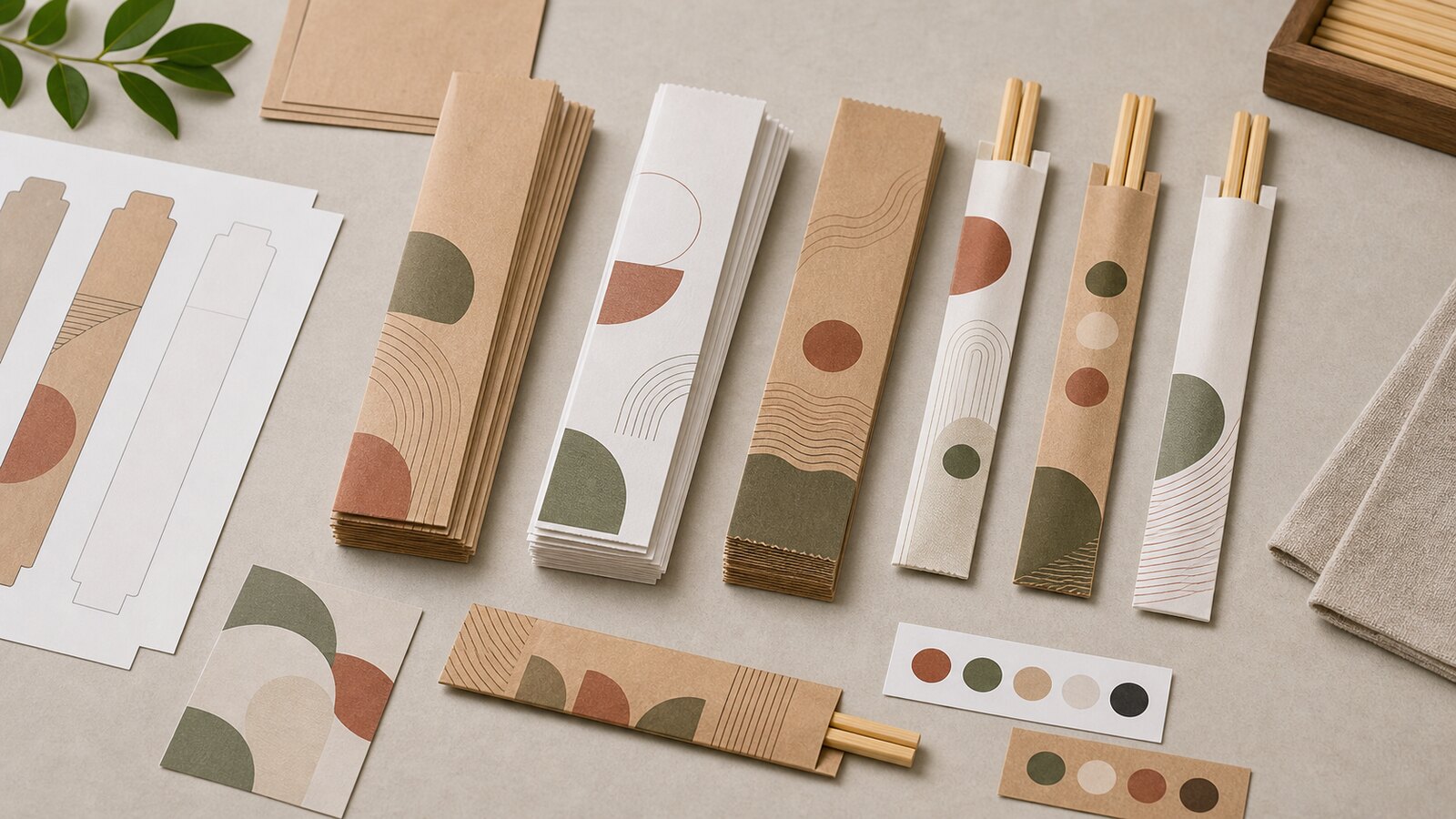
Quick answer: A custom printed chopstick sleeve is a small rectangular paper wrapper that holds a pair of disposable chopsticks. It carries the restaurant or brand artwork — logo, tagline, social handle, or full illustration — printed onto the front face. Sleeves are the cheapest brand-impression surface in foodservice packaging, costing roughly $0.004 – $0.012 per piece at factory-direct B2B volumes, and the only piece of packaging every customer physically touches during a meal.


Why chopstick sleeves matter as a brand vehicle

A printed sleeve does three jobs that no other piece of restaurant packaging does at the same cost.

It sits in the customer’s hand for the entire meal. It gets photographed for social media when food arrives. And it travels home in takeout bags, extending the brand impression long after the customer leaves. For sushi chains, boba shops, ghost kitchens, and event caterers, the sleeve is often the single highest ROI piece of branded disposable tableware in the kit.

That’s why mid-size restaurant groups (50–500 locations) are the fastest-growing segment of our custom chopstick sleeve orders — the unit economics work even at modest store counts, and the brand-consistency win compounds at scale.


Sleeve paper materials, compared

Most B2B buyers default to white kraft paper without realizing how much the substrate choice affects print quality, perceived premium, and FSC compliance.

Paper typeBest forFSC available?Relative cost
White kraft (A-grade)Full-color CMYK, premium chainsYes1.0x (baseline)
Natural unbleached kraftSustainability-led brands, ramen / sobaYes0.9x
Glassine (translucent)Premium sushi, omakase, giftingLimited1.4x – 1.8x
Coated white art paperPhotographic full-color, hotel groupsYes1.3x
100% recycled kraftEU retail-facing brandsYes (FSC Recycled)1.1x – 1.2x

known factory trick is to print samples on reserved A-grade kraft and ship bulk on B-grade. Color reads 5–8% lighter, edges go fuzzy. Lock the pulp grade in the PO, not just the Pantone target. We cover this and other supplier-vetting traps in our 2026 supplier guide.


The three print methods on chopstick sleeves

Sleeve printing uses one (or two combined) of three methods. Picking the right one depends on volume, color count, and whether you want a metallic accent.

1. Offset CMYK — the high-volume default

Offset transfers ink from metal plates through rollers onto the paper. It produces sharp full-color artwork and amortizes the plate cost over high volumes. For chopstick sleeves: MOQ ~20,000 for 1–2 spot colors, ~50,000 for 4-color CMYK. Plate setup runs $120–$300 per design. Per-sleeve cost drops to $0.004–$0.008 at high volume.

2. Digital — the short-run and variable-artwork option

Digital print accepts orders from 5,000 sleeves with no plates, no setup fee. Per-sleeve cost is higher ($0.008–$0.015), but total project cost wins for runs under ~25,000 sleeves. Useful for seasonal menus, wedding favors, sampling kits, and trial-order pilots before committing to offset.

3. Hot-stamp foil — for metallic accents

A heated die presses metallic foil (gold, silver, copper, rose gold, holographic) onto the paper. One foil color per design, MOQ ~30,000 sleeves, die cost $80–$250. Often combined with offset CMYK on the same sleeve — offset for the colorful artwork, hot-stamp for the brand mark. Hotels and luxury sushi brands frequently use this combination.

For a full cost-and-decision comparison of all three methods on chopsticks themselves (not just sleeves), see our printing methods deep-dive.


Standard sleeve sizes (matching chopstick length)

Sleeve dimensions track the chopstick length they wrap. The two standard restaurant lengths in 2026 are 21 cm (the global default) and 23 cm (the Japanese tensogue / premium default). The sleeve adds about 0–2 mm on each side for a comfortable slide-on.

Chopstick lengthSleeve dimensionUse case
19 cm20 × 4.5 cmKids menu, dessert, sampling
21 cm22 × 5 cmGlobal default — sushi, ramen, fast-casual
23 cm24 × 5 cmPremium tensogue, omakase, hotels
24 cm25 × 5.5 cmLarge-format dining, banquet

Custom sleeve sizes outside these defaults are available but typically need a 50,000+ MOQ to justify the die change.


MOQ tiers in 2026 — print method dictates the floor

Print methodMOQUnit cost (USD)Plate / setup
Digital (1–4 color)5,000$0.008 – $0.015None
Offset, 1–2 spot color20,000$0.005 – $0.010$120 – $180
Offset, 4-color CMYK50,000$0.004 – $0.008$200 – $300
Offset + hot-stamp foil50,000$0.007 – $0.012$300 – $450 (plates + die)
Premium glassine + offset30,000$0.010 – $0.018$200 – $300

For new buyers running first orders, the most cost-efficient path is 5,000-sleeve digital trial first (proves artwork on real product), then 20,000 offset run once the design is locked. This is the same pattern we cover in the first-order MOQ guide.


Lead time and artwork approval workflow

Production timeline for printed sleeves is shorter than custom chopsticks themselves because the bottleneck is paper printing, not wood preparation.

  1. Artwork brief (Day 0): customer sends vector logo (AI/EPS/PDF) plus Pantone or hex color targets.
  2. Digital proof (Day 1–3): factory returns a PDF mockup with dimensions and color callouts.
  3. Pre-production sample (Day 5–10): 50–200 actual printed sleeves shipped to customer for sign-off. $30–$80 sample fee, credited toward production order.
  4. Production (Day 10–30): paper cutting, printing, glue lamination, drying, QC. Net ~18–25 days for offset, 10–15 days for digital.
  5. Sea freight (Day 30+): 18–35 days to US / EU / AU ports. Air freight 3–7 days for small batches at ~3x sea cost.

Skip the pre-production sample at your own risk. Color on a PDF screen and color on coated paper diverge enough that we’ve seen 4–6 reorder cycles for brands who relied only on digital proofs.


The four specs nobody talks about in standard quotes

Most supplier quotes list paper grade, print method, MOQ, and lead time. The four specs below are usually missing from quotes and matter enough to put in the PO contract section.

1. Pulp grade (A-grade vs B-grade kraft)

A-grade kraft has denser fibers and a whiter, smoother surface. B-grade is what most factories default to on bulk runs. Lock A-grade in the PO if you want the bulk run to match your approved sample.

2. Pantone fidelity vs CMYK simulation

If your brand has a true Pantone spot color (e.g., Pantone 287 navy), specify spot-color offset, not 4-color CMYK simulation. CMYK builds shift noticeably on vivid blues, greens, and oranges. Spot color adds ~$80–$120 per color to the plate cost but eliminates the color drift.

3. Adhesive food-safety

The glue along the seam where the sleeve closes is in direct or near-contact with the chopsticks. Specify US FDA 21 CFR 175.105 or EU Regulation 10/2011 compliant adhesive. Some low-cost factories use industrial glues that fail food-contact migration tests.

4. Printing ink food-grade certification — the FSC gap

This is the one most buyers miss. FSC certification covers the wood and paper substrate only. It does not cover the printing ink, the lacquer, or the adhesive. A factory can hand you a fully stamped FSC document package and still use inks that wouldn’t pass FDA migration tests on direct food-contact substrates.

The questions to add to your RFP:

  • Is the printing ink certified under US FDA 21 CFR 175.300 or EU Regulation No 10/2011?
  • Is ink-side compliance documented under Swiss Ordinance 817.023.21 Annex 10 or German BfR Recommendation XXXVI (both cover food-grade printing on cellulose)?
  • Do you run 40 °C / 10-day migration testing onto cellulose substrates as part of pre-shipment QC?

Most factories pause on the second question. The pause itself is diagnostic.


Sample policy: three ways to test before committing

  1. Free blank sample. 50–100 plain (unprinted) sleeves shipped at our cost, ~3–5 days. For evaluating paper grade, weight, and feel.
  2. $49 printed sample kit. Ships in 5–10 days. Includes printed sleeves in your artwork, three paper grades, and a Pantone reference chart. Cost credited toward the production order. Order the printed kit.
  3. 1,000–5,000-piece paid trial. Digital print run with no plate cost. Lets you put real branded sleeves in customers’ hands for a single-location pilot before committing to offset MOQ. $30–$50 per 1,000.

Where to next

If you know what you want, request a quote with your target quantity and we’ll come back with a full breakdown plus the printed sample kit shipped.

If you’re still figuring out the broader chopstick build (wood species, MOQ tiers, full kit composition), the bamboo vs birchwood vs aspen comparison and the 2026 MOQ guide are the two posts to read next.

And if the FSC ink-gap surprised you, the longer treatment is in how to choose a custom chopstick supplier in 2026.

About Diningprint

Diningprint is a B2B custom-printed disposable-tableware factory shipping to restaurants, cafés, food brands, hotels, and event caterers in 60+ countries. Because we run our own production line — paper printing, sleeve lamination, hot stamping, kit packing — we control pulp grade, ink certification, and FSC chain-of-custody batch-to-batch. See the catalogue, preview your logo at the customizer, or order the printed sample kit.

Industry context in this post draws on Diningprint’s direct production experience plus an anonymized 20-year veteran Northern China factory director’s account. Prices and MOQs are typical 2026 ranges; final quotes vary with artwork complexity, FSC status, paper grade, and freight market conditions.

Frequently asked questions

Quick answers from buyers like you

What is the minimum order quantity (MOQ) for custom printed chopstick sleeves?

MOQ depends on print method. Digital print accepts orders from 5,000 sleeves with no plates. Offset 1–2 spot color starts at 20,000 sleeves; full-color CMYK offset starts at 50,000 sleeves. Combining offset with hot-stamp foil for metallic accents typically requires 50,000+ sleeves.

How much do custom printed chopstick sleeves cost per piece?

Factory-direct unit cost in 2026 ranges $0.004–$0.012 per sleeve. Digital print runs $0.008–$0.015; offset 1–2 spot color $0.005–$0.010; full-color CMYK offset $0.004–$0.008; premium glassine plus offset $0.010–$0.018. Add roughly 10–20% for FSC-certified paper.

Does FSC certification cover the printing ink on the sleeve?

No. This is the most common misconception. FSC certification covers the wood and paper substrate only. It does not certify the printing ink, the adhesive, or any lacquer. A factory can hold valid FSC documents and still use inks that fail FDA migration tests. Ask separately for ink certification under FDA 21 CFR 175.300, EU 10/2011, Swiss Ordinance 817.023.21 Annex 10, or German BfR Recommendation XXXVI.

What's the difference between offset, digital, and hot-stamp printing on chopstick sleeves?

Offset uses metal plates to transfer CMYK ink onto paper — sharp full-color artwork, lowest per-unit cost at volume, MOQ 20,000+. Digital uses inkjet-style heads with no plates — accepts orders from 5,000, higher per-unit cost but no setup fees, great for short runs and variable artwork. Hot-stamp foil presses metallic foil (gold, silver, copper) onto paper using a heated die — one foil color per design, MOQ 30,000, typically combined with offset for premium accents.

What paper sleeve size matches a standard 21 cm chopstick?

A 22 × 5 cm sleeve fits a standard 21 cm chopstick with comfortable slide-on clearance. 21 cm is the global default for sushi, ramen, and fast-casual chains. Premium 23 cm tensogue chopsticks use a 24 × 5 cm sleeve; kids-menu 19 cm chopsticks use a 20 × 4.5 cm sleeve.

Why does the bulk sleeve color look different from the approved sample?

The most common cause is pulp grade. Quality factories print samples on reserved A-grade kraft but default to B-grade on bulk runs unless A-grade is specifically locked in the PO. Same Pantone, same ink, but B-grade reads 5–8% lighter with fuzzier edges. The fix is a one-line PO clause specifying A-grade kraft and a Pantone or hex color spec instead of 'matching the sample.'

How long does it take to produce custom printed chopstick sleeves?

Production runs 10–15 days for digital and 18–25 days for offset, after artwork approval. The artwork approval workflow typically adds 5–10 days for a pre-production sample (50–200 real printed sleeves shipped for sign-off) — skip the sample at your own risk. Sea freight adds 18–35 days to US/EU/AU ports; air freight 3–7 days at ~3x sea cost.

Can I order custom printed chopstick sleeves without the chopsticks?

Yes. Many established restaurant operators source chopsticks locally and order only the printed sleeves from a factory specializing in paper printing. Per-sleeve cost is the same; you'll typically pay separate freight for two smaller cartons. We support sleeve-only orders from 5,000 pieces (digital) or 20,000 pieces (offset).

Are recycled paper chopstick sleeves a good fit for sustainability claims?

Yes for most EU retail-facing brands. 100% recycled kraft sleeves can carry FSC Recycled certification, qualify for most retailer ESG audits, and add roughly 10–20% per-unit cost over virgin kraft. The visual trade-off is a slightly speckled, less uniform substrate — which many sustainability-led brands actively want for the visual ESG cue. Print fidelity is acceptable for solid colors and bold typography, slightly weaker for photographic CMYK.

Read next

Keep going on related sourcing topics.

Guide

Hot Stamp vs Offset vs Digital: Custom Chopstick Printing Methods Compared

Hot stamp for premium foil logos. Offset for high-volume full-color sleeves. Digital for small runs and variable artwork. Here's the cost, MOQ, and decision framework for each.

Read article

Guide

How to Choose a Custom Chopstick Supplier: 2026 Restaurant Owner's Guide

MOQ, real unit costs, lead times, FSC compliance, and the 10 questions every restaurant buyer should ask a chopstick factory before signing a PO.

Read article

Guide

Custom Chopstick MOQ Explained: How Much Should You Order for Your First Run?

Real entry MOQ is 20,000 pairs. Below that, you have a free sample, a $49 printed kit, and a fixed 1,000 pc paid trial path. Here's how to pick the right one for your first order.

Read article

Guide

Bamboo vs Birchwood vs Aspen: Which Chopstick Wood Is Right for Your Restaurant?

Bamboo is best for 80% of restaurants. Birchwood is the sushi-grade premium choice. Aspen is the budget option that fades fast. Here's exactly how each wood performs on strength, print, cost, and sustainability.

Read article

For your industry

Custom-printed chopsticks for sushi restaurants.

Custom-printed birchwood tensogue chopsticks for sushi restaurants — 200/210/240 mm hand-tipped grade, FSC-certified, $0.015–$0.025 per pair at MOQ 20,000. Branded paper sleeves with full-color CMYK or hot-stamped gold foil. We ship to omakase bars, 5-location independents, and 200-store franchise groups across 60+ countries.

See guide

For your industry

Branded takeout packaging for ghost kitchens.

Custom-printed disposable tableware for ghost kitchens, virtual brands, and delivery-first restaurant groups — branded chopstick sleeves, wooden cutlery kits, and printed paper napkins. MOQ from 5,000 kits (digital) or 20,000 kits (offset), unit cost $0.025–$0.045 per kit. The packaging that arrives at the customer's door is your only brand surface — we make it count.

See guide

For your industry

Custom chopsticks & disposable tableware for event catering.

Custom wooden cutlery kits, branded chopsticks, and printed napkins for event catering, weddings, festivals, and corporate dinners. 3-piece wooden kit (fork + spoon + knife + napkin in custom sleeve) at $0.030–$0.045 per kit, MOQ 5,000 (digital) or 20,000 (offset). Laser-engraved chopsticks with couple's names available from 5,000 pairs. Lead time 25–30 days plus freight.

See guide