All articles

June 27, 2026 · Updated August 31, 2026

By Sam Gao, Founder of Diningprint

Custom Chopstick Sleeves for Sushi Restaurants: MOQ & Quotes

Match a sleeve to your sushi service, understand the 20,000 / 50,000 production MOQ, approve a sample, and send a factory-ready quote request.

  • custom chopstick sleeves
  • sushi restaurants
  • ramen shops
  • omakase
  • takeout packaging
  • dieline
  • FSC
  • 2026 restaurant trends
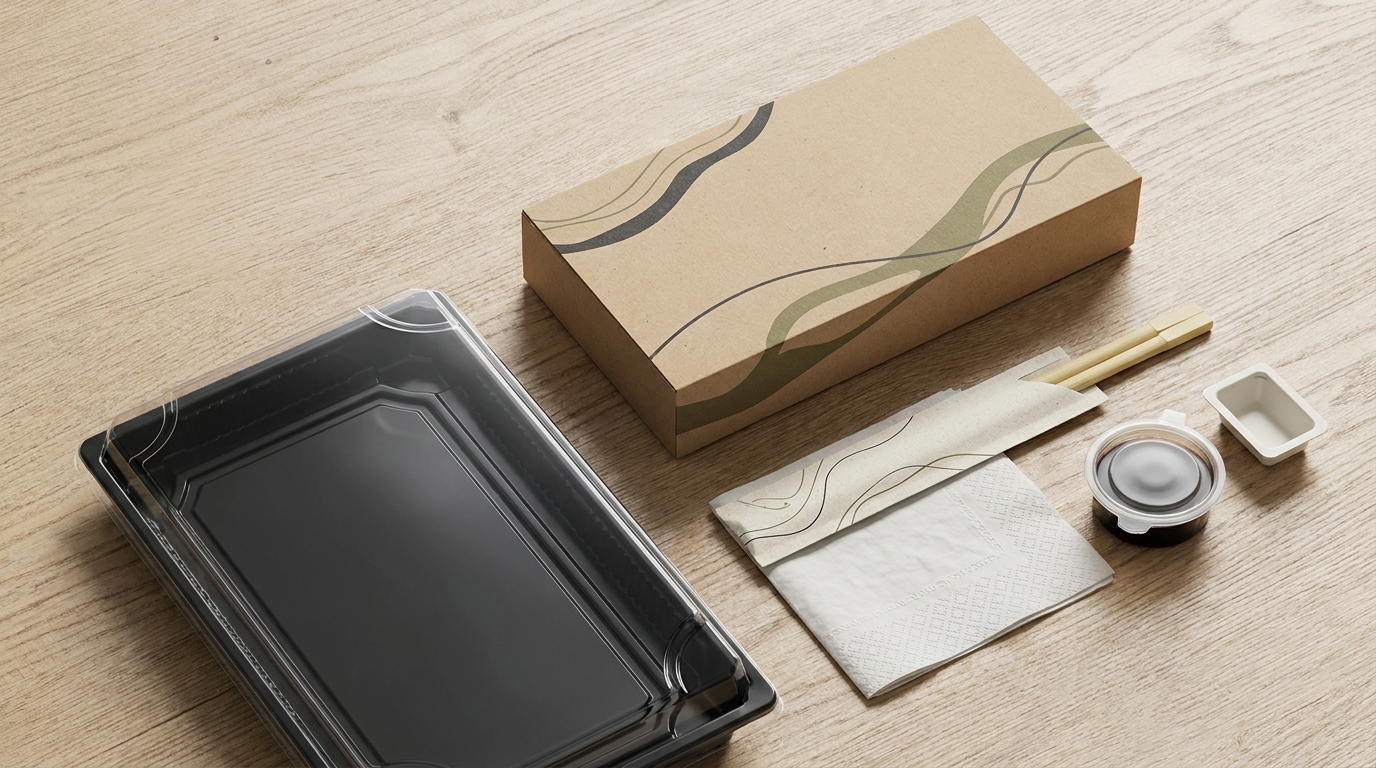
Sushi takeaway scene with chopstick sleeve bamboo chopsticks napkin sauce cup and paperboard packaging
Topic-specific visual concept: sushi tray, kraft takeout box, paper chopstick sleeve, bamboo chopsticks, napkin, and sauce cup for sushi and ramen operators.

The chopstick sleeve is one of the few branded items almost every sushi guest touches. It sits on the tray, travels in the takeout bag, and stays visible when a delivery order is opened. This guide is for B2B buyers who need to turn a sleeve idea into a production-ready order: choose the right format, understand the 20,000 / 50,000 production minimums, approve a sample, and send a complete request for quotation.

That specification matters beyond dine-in service. The National Restaurant Association's 2025 off-premises report describes takeout and delivery as routine customer behavior, while McKinsey's 2026 restaurant research reports that pickup frequency grew as value-conscious diners sought convenience without delivery premiums. A printed sleeve gives the same chopstick presentation a consistent brand surface across the counter, dining room, and takeaway bag.

The 30-second sourcing decision

Choose the service format before preparing artwork. This keeps the first quote focused on a sleeve the operation can actually reorder.

Sushi operationStarting formatChopstickPrint routeProduction path
Daily dine-in or takeawayOpen / half paper sleeve210 mm bamboo twin1–2 spot colorsApprove a sample, then 20,000+ pairs
Delivery and cateringFull paper wrap or chopsticks + napkin kit210 mm bamboo twin or wrapped set1–2 spot colors; CMYK only when needed20,000 spot-color or 50,000 CMYK
Omakase, hotel, or premium conceptClean half sleeve or premium full sleeve210 mm bamboo tensogueSpot color with optional foilSample approval, then project-specific quote
Multi-location restaurant groupOne master layout with controlled artwork zonesStandardized by service tierSpot color for the core design; CMYK for approved campaignsLock the system, then consolidate volume

Sleeve formats and standard sushi chopstick specs

  • Open / half paper sleeve: leaves most of the chopstick visible and uses a compact printed band. It is the simplest format for dine-in counters, casual sushi, and ramen.
  • Full paper sleeve: encloses the chopsticks and gives the front and back to artwork. It is usually the better fit for takeaway, delivery, and catering.
  • Chopsticks + napkin kit: keeps the napkin and chopsticks together for lunch sets, delivery orders, and event trays.
  • Premium sleeve: uses a cleaner paper stock, restrained spot color, or foil accent with tensogue chopsticks for omakase and hotel service.

Match the sleeve to the actual chopstick before approving the design. Diningprint's common sushi starting specifications are 210 mm bamboo twin for everyday service and 210 mm bamboo tensogue for a more premium presentation. If an existing sleeve must be matched, send its flat dimensions and a photo beside a ruler. For exact bleed, safe-zone, and file rules, use the chopstick sleeve dieline reference.

How the 20,000 / 50,000 production MOQ works

Production minimums are driven by the printing process and the number of artwork versions, not only by restaurant count:

  • 20,000 pairs / sleeves: the usual Diningprint production floor for standard chopsticks with a 1–2 color printed paper sleeve.
  • 50,000 pairs / sleeves: the usual starting point for full-color CMYK artwork.
  • Project-specific higher MOQ: custom chopstick shape, custom wood or length, unusual die-cut sleeve, or combined print and foil work.

Diningprint coordinates factory-direct B2B production rather than small retail runs. A project below its applicable production MOQ should use the sample-approval route, not a small production order. For paper grades, print methods, and the documentation questions behind a bulk sleeve order, continue to the complete custom printed chopstick sleeve guide.

Approve the sample before bulk production

Use a material sample when the paper and chopstick still need to be selected. Use a printed proof when the material is set and the artwork needs approval.

  • Material sample: unprinted sleeves and representative chopsticks for checking paper feel, wood surface, length, and sleeve fit. The sample is free for qualified B2B buyers; the buyer covers courier freight.
  • Printed proof: the logo and artwork printed on the intended sleeve material for checking color, sharpness, folds, and placement. The sample is free; any one-time plate or tooling setup for custom artwork is quoted and confirmed separately, and the buyer covers courier freight.

A PDF proof confirms layout, but it cannot show paper feel, real ink behavior, seam quality, or how tightly the sleeve fits the chopstick. The dieline-to-pre-production-sample workflow explains the approval sequence.

Artwork to prepare

  • A vector logo in AI, EPS, SVG, or production-ready PDF format, with fonts outlined.
  • Pantone references for spot colors or a CMYK build for full-color artwork.
  • Final bilingual copy, QR code, social handle, and any reorder or loyalty message.
  • The destination market if the design includes FSC, compostable, recyclable, or other environmental wording.
  • One approved artwork version per SKU, or a clear list of restaurant-location variants.

Do not send a screenshot of a menu logo as the production file. Use the dieline and artwork reference to check bleed, safe areas, outlined fonts, and QR-code spacing.

Quote request checklist

Include the following information in the first request so the quote can be based on a real production specification:

  1. Sleeve format: open / half sleeve, full sleeve, or chopsticks + napkin kit.
  2. Chopstick profile and length: for example, 210 mm bamboo twin or 210 mm bamboo tensogue.
  3. Quantity: first-order volume and likely reorder cadence.
  4. Artwork: vector file, color count, and number of artwork versions.
  5. Paper and finish: white or natural kraft, premium stock, or optional foil.
  6. Destination: country, delivery port, and requested Incoterm.
  7. Documentation: FSC route, food-contact documentation, or buyer-specific audit requirements.
  8. Packing: sleeves supplied alone or assembled with chopsticks, carton labels, and SKU separation.

Incoming QC for the first production order

Approve the physical product, not only the artwork. Open cartons from different positions in the shipment and check the sleeve and chopstick together.

CheckAcceptReject
PrintSharp logo and color consistent with the approved proofBlurred edges, missing print, or visible color drift
Fold and seamSquare fold, clean adhesive line, sleeve holds its shapeOpen seam, glue bleed, wrinkling, or skewed fold
FitSlides on and off without crushing the paperToo tight for the chopstick profile or loose enough to fall off
CleanlinessDry paper, neutral smell, no dust insideDamp or musty odor, oil marks, dust, or loose fragments
ChopstickSmooth surface and consistent approved gradeOpen split, black line, loose fiber, rough tip, or severe warping
PackingCorrect count, carton mark, and SKU separationShort count, mixed artwork, or damaged inner packs

For photo-based rejection examples covering black lines, splits, and rough bamboo fiber, use the bamboo chopstick QC checklist.

If the sleeve carries a sustainability claim

Use specific, documented wording rather than a broad claim such as "eco-friendly." The National Restaurant Association's 2026 culinary forecast lists compostable and reusable packaging among its top trends, but trend language is not proof of compliance. Confirm the certificate route and destination-market wording before printing FSC, compostable, biodegradable, or recyclable claims. The green-claims guide explains the documentation questions.

Source notes

Sleeve formats, production MOQ, artwork, sample approval, and QC guidance on this page are based on Diningprint's 2026 quote-book and production-coordination records. Final requirements vary by artwork, paper, print route, quantity, destination, and requested documentation. The linked 2025–2026 National Restaurant Association and McKinsey sources provide restaurant-channel context; they do not determine a project's production specification.

Request a sushi chopstick sleeve quote

Send the checklist above and Diningprint will confirm the available format, production MOQ, sample route, and export-ready quotation. Start with the sushi restaurant supplies page to compare products, upload the specification through the sushi quote form, or preview the logo in the tableware designer.

Frequently asked questions

Quick answers from buyers like you

What is the MOQ for custom chopstick sleeves for a sushi restaurant?

Diningprint production starts at 20,000 pairs or sleeves for standard chopsticks with 1-2 spot-color printing and 50,000 for full-color CMYK. Custom shapes, wood, lengths, and combined foil work may require a higher project-specific MOQ. Below the applicable MOQ, approve a sample rather than requesting a small production run.

Should sushi delivery use a different chopstick sleeve from dine-in service?

An open or half paper sleeve is the simplest format for dine-in service. A full paper sleeve usually suits takeaway and delivery because it encloses the chopsticks and provides front-and-back print space. Premium omakase service may use a cleaner paper stock or a restrained foil accent.

Can I approve a printed sushi chopstick sleeve before bulk production?

Yes. The sample is free for qualified B2B buyers and the buyer covers courier freight. Any one-time plate or tooling setup for custom artwork is quoted and confirmed separately. Review the real paper, print color, fold, seam, and chopstick fit before approving production at the applicable MOQ.

Read next

Keep going on related sourcing topics.

Guide

Custom Printed & Engraved Chopsticks for Restaurants | Bulk Factory Pricing

Choose printed sleeves or engraving for restaurant chopsticks, with real MOQ, sample proofing, bulk pricing, and a factory-direct quote path.

Read article

Guide

Best Wood for Chopsticks: Bamboo vs Birch vs Aspen (Buyer's Guide 2026)

A restaurant buyer guide to bamboo, birchwood, and aspen chopsticks: best use cases, cost, MOQ, FSC, print quality, and factory quote paths.

Read article

Guide

Hot Stamp vs Offset vs Digital: Custom Chopstick Printing Methods Compared

Hot stamp for premium foil logos. Offset for high-volume full-color sleeves. Digital for proofing and variable artwork. Here's the cost, MOQ, and decision framework for each.

Read article

Guide

Compostable vs Biodegradable vs Recyclable: The Green Claims That Get You Fined

"Biodegradable" is the single highest-risk word on disposable foodware — deceptive under the FTC, unlawful on plastic in California, and banned generically in the EU from September 2026. Here's what each green claim legally means, and how to make one you can defend.

Read article

For your industry

Custom printed chopsticks and sushi restaurant supplies for wholesale orders.

Start with the items every sushi customer actually touches: bamboo chopsticks, printed chopstick sleeves, napkins, sauce cups, paper bags, and simple takeaway boxes or trays when needed. The tableware does not need to be complicated; the goal is a clean sushi experience with one consistent brand impression.

See guide

For your industry

Custom chopsticks and branded tableware for Chinese restaurants.

Branded chopsticks, printed paper sleeves, napkins, and biodegradable cutlery kits for Chinese restaurants, hot pot, dim sum, noodle shops, banquets, and Asian catering. Build a takeout-ready kit with chopsticks, spoon, napkin, toothpick, and custom wrapper.

See guide

For your industry

Biodegradable cutlery kits and custom tableware for event catering.

Custom wooden cutlery kits, branded chopsticks, and printed napkins for event catering, weddings, festivals, stadium foodservice, and corporate dinners. A 3-piece wooden kit (fork + spoon + knife + napkin in a custom sleeve) starts at a 20,000-kit production MOQ and is priced on request. Lead time is 25-30 days plus freight.

See guide