By Sam Gao, Founder of Diningprint
FSC vs FDA vs BSCI vs BRC: The Certification Stack Every B2B Tableware Buyer Should Demand
FSC covers the paper, not the ink. FDA covers the product, not the factory. BSCI covers the workers, not the food safety. Here's what each certification on disposable tableware actually proves — and the stack you should demand by market.
- certifications
- FSC
- FDA
- BSCI
- BRCGS
- LFGB
- food safety
- compliance
- B2B
- disposable tableware
- compostable
Quick answers from buyers like you
What certifications should disposable chopsticks and wooden cutlery have?
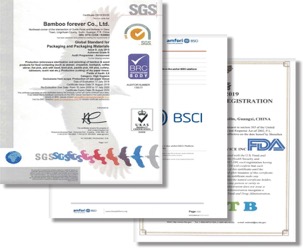
At minimum: FSC (responsible forestry / chain-of-custody for the wood), a food-contact safety certification for the destination market (FDA 21 CFR for the US; EU Regulation 1935/2004 + 10/2011, or German LFGB/BfR, for the EU), and — for EU retail-facing or large hospitality buyers — BSCI (social compliance) and ideally BRCGS (food-safety management). Compostability standards (EN 13432, ASTM D6400, BPI) apply only if you market the product as compostable. No single certificate is sufficient because each covers a different risk.
Does FSC certification mean a product is food-safe?
No. This is the most common misconception. FSC certifies only that the wood or paper came from responsibly managed forests, tracked through a chain of custody. It says nothing about the printing ink, the adhesive, the lacquer, or any food-contact safety property. A product can be fully FSC-certified and still be printed with inks that fail a food-contact migration test. Food safety is a separate certification: FDA 21 CFR, EU 10/2011, or LFGB.
What's the difference between FDA and LFGB food-contact certification?
Both certify food-contact safety, but LFGB (the German Food and Feed Code) is generally stricter. FDA 21 CFR governs US food-contact materials by component (21 CFR 176 for paper, 175.300 for coatings/inks, 175.105 for adhesives). LFGB adds sensory testing — taste and odor transfer — that the FDA does not require, so an LFGB pass is often treated as a premium credential for EU-facing buyers because it clears a higher bar.
What is BSCI and do I need it?
BSCI (amfori Business Social Compliance Initiative) audits factory working conditions — wages, hours, health and safety, no child or forced labor — and grades the factory A–E. It does not certify product safety. You need it if you sell into European retail chains or large branded hospitality groups, because their ESG reporting requires a valid BSCI audit from every supplier. For US-only or smaller buyers it's often optional but increasingly requested.
What does BRCGS certify, and how is it different from FDA?
BRCGS (formerly BRC) certifies that the factory operates a documented food-safety management system — traceability, hygiene, hazard analysis — under the BRCGS Packaging Materials standard. Where FDA or LFGB certify the product, BRCGS certifies the process and facility that makes it. Retail and premium buyers ask for it as proof the supplier is auditable and consistent batch-to-batch, not just compliant on a single tested sample.
Is 'biodegradable' the same as 'compostable' for wooden tableware?
No. 'Biodegradable' is an unregulated marketing word — almost any untreated wood eventually breaks down. 'Compostable' is a regulated claim requiring certification: EN 13432 (EU), ASTM D6400 (US), BPI (US third-party verification), or OK Compost / AS 4736. Untreated bamboo and birchwood generally meet these standards, but a printed or lacquered surface can disqualify the claim unless the ink and coating are themselves compostable. If you market the product as compostable, the certification must cover the finished printed product.
Which certifications do I need to import disposable tableware into the EU?
For the EU you should expect to need: FSC (responsible forestry), food-contact safety compliance under EU Regulation 1935/2004 plus 10/2011 (for plastic components) or German LFGB/BfR (for paper and printed surfaces), and BSCI (social compliance) if you sell into retail. BRCGS is frequently requested for premium and retail supply, and EN 13432 is required only if you make a compostable claim. The EU is the most demanding market — a supplier serving it usually holds the full stack.
How can I tell if a supplier's certificate is real and not borrowed or expired?
Four checks. First, confirm the certificate holder's legal-entity name matches the factory you're actually buying from, not a trading company. Second, verify the FSC license code (FSC-C######) live in the public FSC database, including the product scope. Third, check the date — FSC and BSCI audits are annual, so anything older than 12 months is a red flag. Fourth, match the certificate's product scope to your item; a certificate for 'paper packaging' does not cover wooden chopsticks. A real factory passes all four instantly.
Why do I need to ask for ink and adhesive certification separately?
Because FSC, BSCI, and BRCGS all say nothing about whether the printing ink and seam adhesive are food-safe. A factory can hold a flawless stack of those three and still print with inks that were never migration-tested. The food-contact safety of the printed and glued surfaces lives in separate documents: the FDA 21 CFR 175.300 / EU 10/2011 / LFGB statement for the ink, and the 21 CFR 175.105 statement for the adhesive. Always request those two specifically.
Keep going on related sourcing topics.
Custom Printed Chopstick Sleeves — Complete B2B Buyer's Guide (2026)
Paper grade, print method, MOQ tier, ink food-safety — and the FSC gap nobody talks about. The complete 2026 buyer's guide to custom printed chopstick sleeves, with real factory specs and PO clauses.
Read article
How to Choose a Custom Chopstick Supplier: 2026 Restaurant Owner's Guide
MOQ, real unit costs, lead times, FSC compliance, and the 10 questions every restaurant buyer should ask a chopstick factory before signing a PO.
Read article
Custom Printed Napkin Bands for Restaurants — B2B Buyer's Guide (2026)
Format, paper grade, print method, MOQ tier, adhesive food-safety — plus the FSC ink-certification gap most factories don't disclose. The 2026 B2B buyer's guide to custom printed napkin bands and belly bands.
Read article
Best Wood for Chopsticks: Bamboo vs Birch vs Aspen (Buyer's Guide 2026)
A restaurant buyer guide to bamboo, birchwood, and aspen chopsticks: best use cases, cost, MOQ, FSC, print quality, and factory quote paths.
Read article
Biodegradable cutlery kits and custom tableware for event catering.
Custom wooden cutlery kits, branded chopsticks, and printed napkins for event catering, weddings, festivals, stadium foodservice, and corporate dinners. A 3-piece wooden kit (fork + spoon + knife + napkin in a custom sleeve) starts at a 20,000-kit production MOQ and is priced on request. Lead time is 25-30 days plus freight.
See guide
Branded takeout packaging for ghost kitchens.
Custom-printed disposable tableware for ghost kitchens, virtual brands, and delivery-first restaurant groups — branded chopstick sleeves, wooden cutlery kits, and printed paper napkins. Production starts at 20,000 kits for eligible branded configurations, with per-kit pricing on request. The packaging that arrives at the customer's door is your only brand surface — we make it count.
See guide
Custom printed chopsticks and sushi restaurant supplies for wholesale orders.
Start with the items every sushi customer actually touches: bamboo chopsticks, printed chopstick sleeves, napkins, sauce cups, paper bags, and simple takeaway boxes or trays when needed. The tableware does not need to be complicated; the goal is a clean sushi experience with one consistent brand impression.
See guide
Custom branded coffee shop packaging and cutlery, factory direct.
Plan printed cups, optional cup sleeves, napkins and takeaway bags around your drink and food service. Request each item independently or coordinate a matching set. Confirm specifications, quantities and artwork for each product before production.
See guide