DPDiningprint
All articles

June 10, 2026

By Sam Gao, Founder of Diningprint

Custom Printed Napkin Bands for Restaurants — B2B Buyer's Guide (2026)

Format, paper grade, print method, MOQ tier, adhesive food-safety — plus the FSC ink-certification gap most factories don't disclose. The 2026 B2B buyer's guide to custom printed napkin bands and belly bands.

  • napkin bands
  • belly bands
  • custom printing
  • B2B
  • packaging
  • FSC
  • food safety
  • restaurant supply
  • event catering
  • coffee shops

TL;DR — Custom printed napkin bands in 2026

  • MOQ starts at 5,000 bands for digital print (no plates), 20,000 for offset 1–2 spot color, 50,000 for full-color CMYK offset.
  • Unit cost ranges $0.005 – $0.018 per band depending on paper grade, print method, and volume.
  • Three formats: classic belly band (napkin only), cutlery-and-napkin rollup band, and pre-fold dispenser band. Pick by serving context, not aesthetic.
  • Lead time is 15–22 days production plus freight.
  • The hidden risk most buyers miss: the band’s adhesive seam sits against a napkin that’s often used to wipe food. Specify FDA / EU 10/2011 food-grade adhesive in the PO, not just "kraft paper band."

Quick answer: what is a custom printed napkin band?

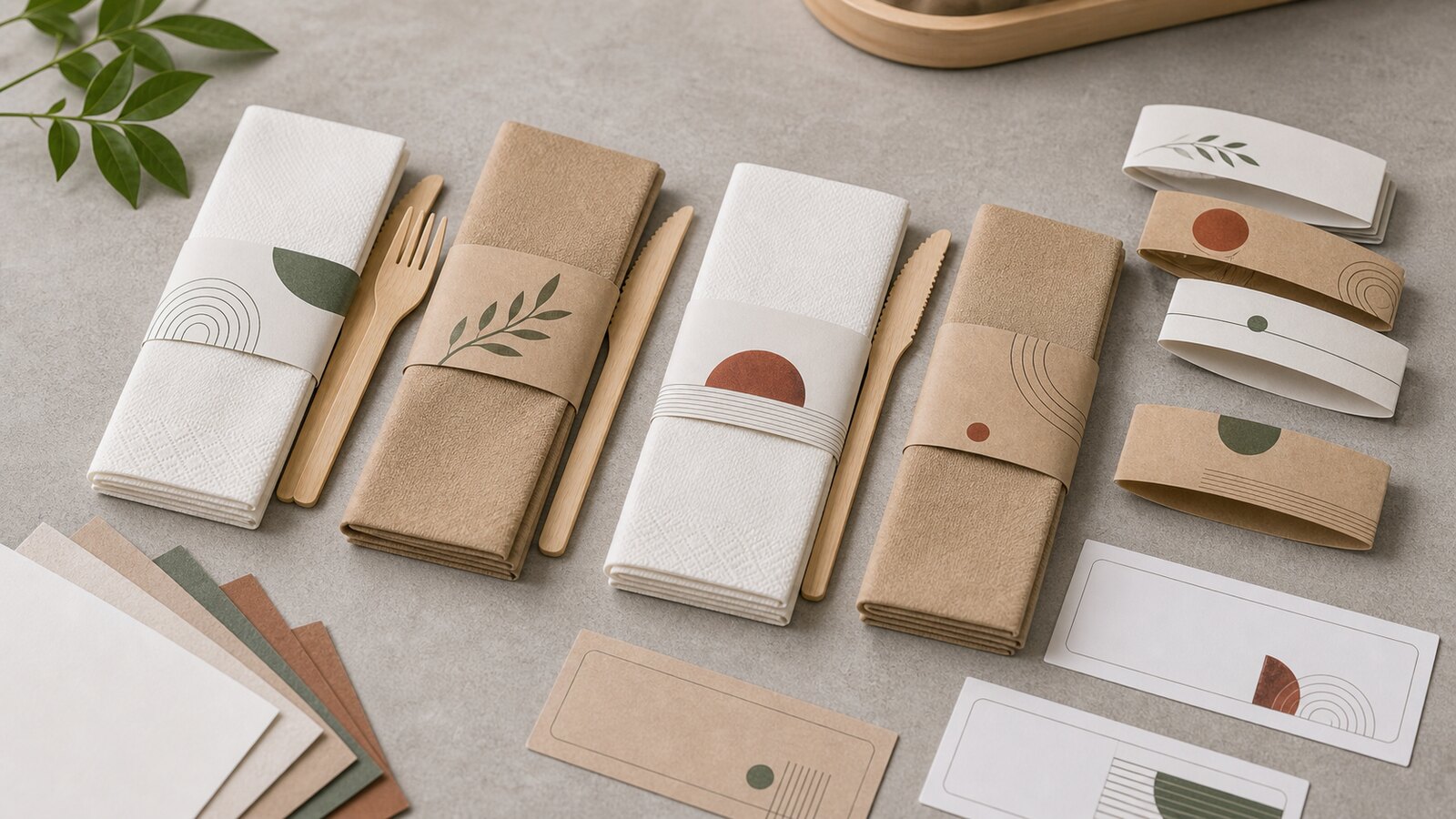
Quick answer: A custom printed napkin band — also called a belly band, napkin sleeve, or napkin wrapper — is a thin paper loop that holds a folded napkin (or a napkin-and-cutlery rollup) in place and carries the restaurant or brand artwork printed on its visible face. Factory-direct unit cost runs $0.005 – $0.018 per band at B2B volumes. Bands solve two problems at once: they keep cutlery rollups tidy on the table or in the takeout bag, and they deliver a brand impression on the most-handled disposable surface at the table.


Why napkin bands are quietly the highest-ROI brand surface in foodservice

For mid-volume restaurants, ghost kitchens, and event caterers, the napkin band hits a unique sweet spot. It costs less than a printed napkin (you brand the wrapper, not the absorbent sheet, which keeps cost down). It survives moisture better than a printed napkin (no ink-bleed risk because the band isn’t used to wipe). And it photographs cleanly because the band stays smooth even as the napkin underneath gets unfolded.

Three categories of operators drive most of our band orders:

  • Coffee shops and bakeries — band around a folded napkin plus a wooden stirrer for cold drinks (see coffee shop SKUs).
  • Event caterers — band around a knife-fork-napkin cutlery rollup, prepped the night before a wedding or corporate event (event catering kits).
  • Sushi and Asian fast-casual — band around chopsticks plus napkin, often replacing the chopstick sleeve as a single-piece kit (sushi restaurant SKUs).

Three napkin band formats — pick by serving context

1. Classic belly band (napkin only)

A short rectangular loop — typically 15–22 cm long and 2–4 cm tall — that wraps a single folded napkin. Used on dine-in tables or in to-go bags as a tidy presentation layer. The band’s open ends are glued with a single seam, leaving the napkin removable without tearing the paper. Best for upscale fast-casual where the napkin appears on the place setting before food.

2. Cutlery-and-napkin rollup band

A longer loop — typically 22–30 cm long — that holds a napkin wrapped around a knife, fork, spoon, or chopstick set. The dominant format for event catering, wedding venues, hotel banquet, and ghost kitchens. The band sits visible on the rollup and travels in the takeout bag, so brand impressions compound. Pairs naturally with our FSC wooden cutlery line.

3. Pre-fold dispenser band

A taller, perforated band — typically 3–6 cm tall — designed to hold a stack of 10–25 napkins together for high-volume dispenser refills. Used at sandwich shops, cafeteria self-service stations, and stadium concessions. The band tears cleanly along a perforation line when a server reloads the dispenser. Cheaper than individual bands but more limited in brand surface.

Most buyers default to format 2 (the rollup band) because it covers the highest-volume use cases — event catering and takeout — while still working on a dine-in table.


Paper grades for napkin bands, compared

The substrate choice drives both print quality and the perceived premium of the finished band. The four most common materials in 2026:

Paper typeBest forFSC available?Relative cost
White kraft (A-grade)Full-color CMYK, restaurant chainsYes1.0x (baseline)
Natural unbleached kraftSustainability-led brands, farm-to-tableYes0.9x
Coated white art paperPhotographic full-color, hotelsYes1.3x
100% recycled kraftEU retail-facing brandsYes (FSC Recycled)1.1x – 1.2x

Glassine and translucent papers are rarely used for napkin bands because they wrinkle visibly against the napkin’s embossed surface. If you want a premium feel, the upgrade path is coated white art paper plus a hot-stamp foil accent, not glassine.


The three print methods on napkin bands

1. Offset CMYK — the high-volume default

Offset transfers ink from metal plates onto the paper at high speed. For napkin bands: MOQ ~20,000 for 1–2 spot colors, ~50,000 for 4-color CMYK. Plate setup runs $100–$280 per design. Per-band cost drops to $0.005–$0.010 at high volume. This is the right method once your artwork is locked and you’re running quarterly reorders.

2. Digital — the short-run and seasonal-artwork option

Digital print accepts orders from 5,000 bands with no plates, no setup fee. Per-band cost is higher ($0.010–$0.018), but total project cost wins for runs under ~25,000 bands. Useful for seasonal menu launches, wedding favors, pop-up events, and small ghost-kitchen brand rollouts. The same trial pattern we recommend for our chopstick sleeves.

3. Hot-stamp foil — for metallic accents

A heated die presses metallic foil (gold, silver, copper, rose gold) onto the paper band. One foil color per design, MOQ ~30,000, die cost $80–$200. Frequently combined with offset CMYK on the same band — offset for the colorful artwork, hot-stamp for the brand mark. Hotel banquet caterers and luxury event venues use this combination heavily.

For a full method comparison across chopsticks and packaging, see the printing methods deep-dive.


Standard band sizes — matching napkin fold and cutlery length

Napkin band dimensions are driven by what they wrap. The four standard sizes in 2026:

FormatBand dimensionsUse case
Quarter-fold napkin (10×10 cm folded)16 × 2.5 cmCoffee shops, bakeries, fast-casual dine-in
Eighth-fold napkin (10×5 cm folded)12 × 2 cmDessert stations, sampling, mini-portion
Cutlery rollup (knife + fork + napkin)25 × 3.5 cmEvent catering, hotels, wedding venues
Cutlery rollup (4-piece + napkin)28 × 4 cmBanquet, gala catering, premium ghost kitchens

Custom sizes outside these defaults are available but typically need a 50,000+ MOQ to justify the die change.


MOQ tiers and 2026 pricing

Print methodMOQUnit cost (USD)Plate / setup
Digital (1–4 color)5,000$0.010 – $0.018None
Offset, 1–2 spot color20,000$0.006 – $0.012$100 – $180
Offset, 4-color CMYK50,000$0.005 – $0.010$180 – $280
Offset + hot-stamp foil50,000$0.008 – $0.014$280 – $420
Coated art paper + offset CMYK30,000$0.008 – $0.013$180 – $280

For first-time buyers, the most cost-efficient sequence is a 5,000-band digital trial first (proves artwork on real paper against a real napkin), then a 20,000-band offset run once the design and color sign-off lands. Same first-order pattern we cover in the MOQ guide.


Lead time and artwork approval workflow

  1. Artwork brief (Day 0): customer sends vector logo (AI / EPS / PDF) plus Pantone or hex color targets.
  2. Digital proof (Day 1–3): factory returns a PDF mockup with dimensions and color callouts.
  3. Pre-production sample (Day 5–10): 50–200 actual printed bands shipped wrapped around real napkin samples for sign-off. $30–$60 sample fee, credited toward the production order.
  4. Production (Day 10–25): paper cutting, printing, glue lamination, drying, QC. Net ~15–22 days for offset, 8–12 days for digital.
  5. Sea freight (Day 25+): 18–35 days to US / EU / AU ports. Air freight 3–7 days for small batches at ~3x sea cost.

Skip the pre-production sample at your own risk. The visual interaction between band ink color and the embossed pattern of the napkin underneath often shifts how the brand reads — a PDF proof can’t simulate this.


The four specs to lock in your PO

1. Adhesive food-safety

The seam glue sits against a napkin that customers use on their face and hands. Specify US FDA 21 CFR 175.105 or EU Regulation 10/2011 compliant adhesive. Some low-cost factories use industrial seam glues that fail food-contact migration tests and may transfer plasticizers to the napkin under heat.

2. Ink food-grade certification — the FSC gap

This is the spec most buyers miss. FSC certification covers the wood and paper substrate only — not the ink, adhesive, or lacquer. A factory can hand you a complete FSC document set and still use inks that wouldn’t pass FDA migration tests on cellulose substrates. Add these RFP questions:

  • Is the ink certified under US FDA 21 CFR 175.300 or EU Regulation No 10/2011?
  • Is ink-side compliance documented under Swiss Ordinance 817.023.21 Annex 10 or German BfR Recommendation XXXVI?
  • Do you run 40 °C / 10-day migration testing onto cellulose as part of pre-shipment QC?

3. Pulp grade (A vs B kraft)

The same A-grade vs B-grade swap that affects chopstick sleeves applies here. Lock A-grade kraft in the PO, not just “kraft paper.” B-grade reads 5–8% lighter against the napkin and the seam looks fuzzier under fluorescent restaurant lighting.

4. Band tension and break strength

A band that’s too tight tears the napkin when the customer pulls the cutlery rollup apart. A band that’s too loose slides off in the takeout bag. Specify a break strength target of 0.8–1.2 kg pull force for the seam. Mid-tier factories rarely measure this, but a one-line PO spec usually surfaces a competent QC reply.


Sample policy: three ways to test before committing

  1. Free blank sample. 50–100 plain (unprinted) bands shipped at our cost, ~3–5 days. For evaluating paper grade, weight, and seam strength.
  2. $49 printed sample kit. Ships in 5–10 days. Includes printed bands in your artwork wrapped around real napkin samples, three paper grades, and a Pantone reference chart. Cost credited toward the production order. Order the printed kit.
  3. 1,000–5,000-band paid trial. Digital print run with no plate cost. Lets you test bands at a single venue or event before committing to offset MOQ. $25–$45 per 1,000.

Pairing napkin bands with other printed disposable surfaces

Most operators buy bands as part of a multi-SKU printed kit. The two most common kit constructions:

  • Coffee shop kit: 2-ply printed napkin + branded wooden stirrer + band around both. Single brand impression, three printed surfaces.
  • Catering rollup: 2-ply napkin + wooden knife + wooden fork + wooden spoon + band around the rollup. Pairs with our wooden cutlery line.

For a more complete view of how to compose the kit and where each printed surface adds versus dilutes brand value, the chopstick sleeves guide covers the same logic for chopstick-led kits.


Where to next

If you know the format and quantity you want, request a quote with target volume and we’ll come back with a full breakdown plus the printed sample kit shipped.

If you’re still figuring out the broader paper-goods kit, the paper products catalogue and the disposable wooden cutlery guide are the next two pages to read.

If the FSC ink-gap surprised you, the longer treatment is in how to choose a custom chopstick supplier in 2026.

About Diningprint

Diningprint is a B2B custom-printed disposable-tableware factory shipping to restaurants, cafés, food brands, hotels, and event caterers in 60+ countries. Because we run our own production line — paper cutting, offset and digital printing, lamination, hot stamping, kit packing — we control pulp grade, ink certification, and FSC chain-of-custody batch-to-batch. See the catalogue, preview your logo at the customizer, or order the printed sample kit.

Industry context in this post draws on Diningprint’s direct production experience plus an anonymized 20-year veteran Northern China factory director’s account. Prices and MOQs are typical 2026 ranges; final quotes vary with artwork complexity, FSC status, paper grade, and freight market conditions.

Frequently asked questions

Quick answers from buyers like you

What is a napkin band, and is it the same as a belly band or napkin sleeve?

Yes — napkin band, belly band, and napkin sleeve all refer to the same product: a thin printed paper loop that wraps around a folded napkin (or a napkin-and-cutlery rollup) to hold it in place and carry restaurant or brand artwork. The terms are used interchangeably across the foodservice supply industry. 'Belly band' is more common in event catering; 'napkin sleeve' is more common in coffee shops; 'napkin band' is the most generic B2B procurement term.

What is the minimum order quantity (MOQ) for custom printed napkin bands?

MOQ depends on print method. Digital print accepts orders from 5,000 bands with no plates. Offset 1–2 spot color starts at 20,000 bands; full-color CMYK offset starts at 50,000 bands. Offset with hot-stamp foil typically requires 50,000+ bands. For first-time orders, the most cost-efficient sequence is a 5,000-band digital trial followed by a 20,000-band offset run once the design is locked.

How much do custom printed napkin bands cost per piece?

Factory-direct unit cost in 2026 ranges $0.005–$0.018 per band. Digital print runs $0.010–$0.018; offset 1–2 spot color $0.006–$0.012; full-color CMYK offset $0.005–$0.010; coated art paper plus offset CMYK $0.008–$0.013; offset plus hot-stamp foil $0.008–$0.014. Add roughly 10–20% for FSC-certified paper.

What size napkin band fits a standard quarter-fold cocktail napkin?

A 16 × 2.5 cm belly band fits a standard 10 × 10 cm quarter-folded napkin with comfortable wrap clearance. For an eighth-fold (10 × 5 cm) napkin used at dessert and sampling stations, the standard band size is 12 × 2 cm. For a knife-fork-napkin cutlery rollup, the band size jumps to 25 × 3.5 cm. For a 4-piece banquet rollup, use 28 × 4 cm.

What paper grades work best for printed napkin bands?

White kraft A-grade is the default for full-color CMYK on restaurant chains. Natural unbleached kraft works for sustainability-led brands at roughly 0.9× the white-kraft cost. Coated white art paper is the upgrade for photographic CMYK and hotel banquet brands at about 1.3× cost. 100% recycled kraft (FSC Recycled) is the EU retail-facing default at 1.1–1.2× cost. Glassine and translucent papers are rarely used because they wrinkle visibly against the embossed napkin underneath.

Does FSC certification cover the printing ink and adhesive on the napkin band?

No — and this is the spec most buyers miss. FSC certification covers the wood and paper substrate only. It does not certify the printing ink, the seam adhesive, or any lacquer. A factory can hold valid FSC documents and still use inks or glues that fail FDA migration tests on cellulose substrates. Ask separately for ink compliance under FDA 21 CFR 175.300, EU 10/2011, Swiss Ordinance 817.023.21 Annex 10, or German BfR Recommendation XXXVI, and adhesive compliance under FDA 21 CFR 175.105 or EU 10/2011.

Can I order napkin bands without the napkins?

Yes. Most operators already source napkins from a local distributor for freight reasons (napkins are bulky and ship at low value-per-cubic-meter), then order printed bands separately. Per-band cost is unchanged. We support band-only orders from 5,000 pieces (digital) or 20,000 pieces (offset), shipping in carton sizes that nest with most standard napkin packaging.

How long does production take for a 20,000-band offset order?

Production runs 15–22 days for offset and 8–12 days for digital, after artwork approval. The artwork approval workflow typically adds 5–10 days for a pre-production sample (50–200 real printed bands wrapped around napkin samples shipped for sign-off) — skip the sample at your own risk. Sea freight adds 18–35 days to US/EU/AU ports; air freight 3–7 days at roughly 3× sea cost.

Why does the band tear my napkin when the customer pulls it off?

Almost always because the seam break-strength is too high — meaning the band itself is stronger than the napkin's tear resistance. Specify a 0.8–1.2 kg pull-force target for the seam in the PO. Mid-tier factories often default to whatever the glue happens to deliver (sometimes 2.0+ kg), which makes the band feel premium-sturdy but tears the napkin. Reducing seam tension solves it without changing paper grade.

Read next

Keep going on related sourcing topics.

Guide

Custom Printed Chopstick Sleeves — Complete B2B Buyer's Guide (2026)

Paper grade, print method, MOQ tier, ink food-safety — and the FSC gap nobody talks about. The complete 2026 buyer's guide to custom printed chopstick sleeves, with real factory specs and PO clauses.

Read article

Guide

Disposable Wooden Cutlery, Factory-Direct: Bulk Wholesale, Biodegradable Sets, and Custom Printing for Restaurants & Caterers

Bulk birchwood forks, FSC bamboo sets, custom-printed sleeves, hot-stamped handles — here's how wooden cutlery actually gets made at the factory, with 2026 unit costs and MOQs.

Read article

Guide

Hot Stamp vs Offset vs Digital: Custom Chopstick Printing Methods Compared

Hot stamp for premium foil logos. Offset for high-volume full-color sleeves. Digital for small runs and variable artwork. Here's the cost, MOQ, and decision framework for each.

Read article

Guide

How to Choose a Custom Chopstick Supplier: 2026 Restaurant Owner's Guide

MOQ, real unit costs, lead times, FSC compliance, and the 10 questions every restaurant buyer should ask a chopstick factory before signing a PO.

Read article

For your industry

Custom packaging for coffee shops & cafés.

Custom-printed coffee stirrers, branded paper napkins, and takeaway cup sleeves for coffee shops and cafés — birchwood stirrers $0.003–$0.006 per piece, MOQ 50,000; printed napkins from $0.008 per piece, MOQ 20,000. FSC-certified, hot-stamp or offset CMYK print, ships to 60+ countries.

See guide

For your industry

Custom chopsticks & disposable tableware for event catering.

Custom wooden cutlery kits, branded chopsticks, and printed napkins for event catering, weddings, festivals, and corporate dinners. 3-piece wooden kit (fork + spoon + knife + napkin in custom sleeve) at $0.030–$0.045 per kit, MOQ 5,000 (digital) or 20,000 (offset). Laser-engraved chopsticks with couple's names available from 5,000 pairs. Lead time 25–30 days plus freight.

See guide

For your industry

Custom-printed chopsticks for sushi restaurants.

Custom-printed birchwood tensogue chopsticks for sushi restaurants — 200/210/240 mm hand-tipped grade, FSC-certified, $0.015–$0.025 per pair at MOQ 20,000. Branded paper sleeves with full-color CMYK or hot-stamped gold foil. We ship to omakase bars, 5-location independents, and 200-store franchise groups across 60+ countries.

See guide

For your industry

Branded takeout packaging for ghost kitchens.

Custom-printed disposable tableware for ghost kitchens, virtual brands, and delivery-first restaurant groups — branded chopstick sleeves, wooden cutlery kits, and printed paper napkins. MOQ from 5,000 kits (digital) or 20,000 kits (offset), unit cost $0.025–$0.045 per kit. The packaging that arrives at the customer's door is your only brand surface — we make it count.

See guide