By Sam Gao, Founder of Diningprint
How to Import Custom Chopsticks & Disposable Tableware from China: Freight, Customs & Incoterms (2026)
Artwork to your warehouse in 45–75 days by sea. Here's the importer's half of the job — Incoterms, HS codes and duty, the fumigation paperwork first-timers miss, container loading, payment protection, and when to pay for air freight.
- importing
- logistics
- freight
- customs
- Incoterms
- HS codes
- DDP
- FOB
- B2B sourcing
- China
- disposable tableware
TL;DR — importing disposable tableware from China
- The whole chain runs artwork → sample → deposit → production → freight → customs → your warehouse — typically 45–75 days by sea, 25–40 by air.
- Incoterms decide who does what. For first-time importers, DDP (supplier handles everything to your door) is the lowest-friction; FOB gives you control and usually the lowest landed cost once you have a freight forwarder.
- Disposable wooden tableware generally ships duty-light into the US, EU, UK, and Australia, but you still owe import VAT/GST and need the right commodity (HS) code.
- The two documents that cause 90% of customs delays: a mismatched commercial invoice and a missing fumigation / phytosanitary certificate for wood/bamboo.
Quick answer: how do you import custom chopsticks and tableware from China?
Quick answer: You approve artwork and a pre-production sample, pay a deposit (usually 30%), the factory produces in 18–30 days, then the goods move by sea or air under an agreed Incoterm (FOB, CIF, or DDP). At the destination port your customs broker clears the shipment using the correct HS code, you pay any duty plus import VAT/GST, and a trucker delivers to your warehouse. End to end, budget 45–75 days by sea or 25–40 by air. The single biggest variable is the Incoterm — it determines who arranges freight, who clears customs, and where the cost and risk transfer from supplier to you.
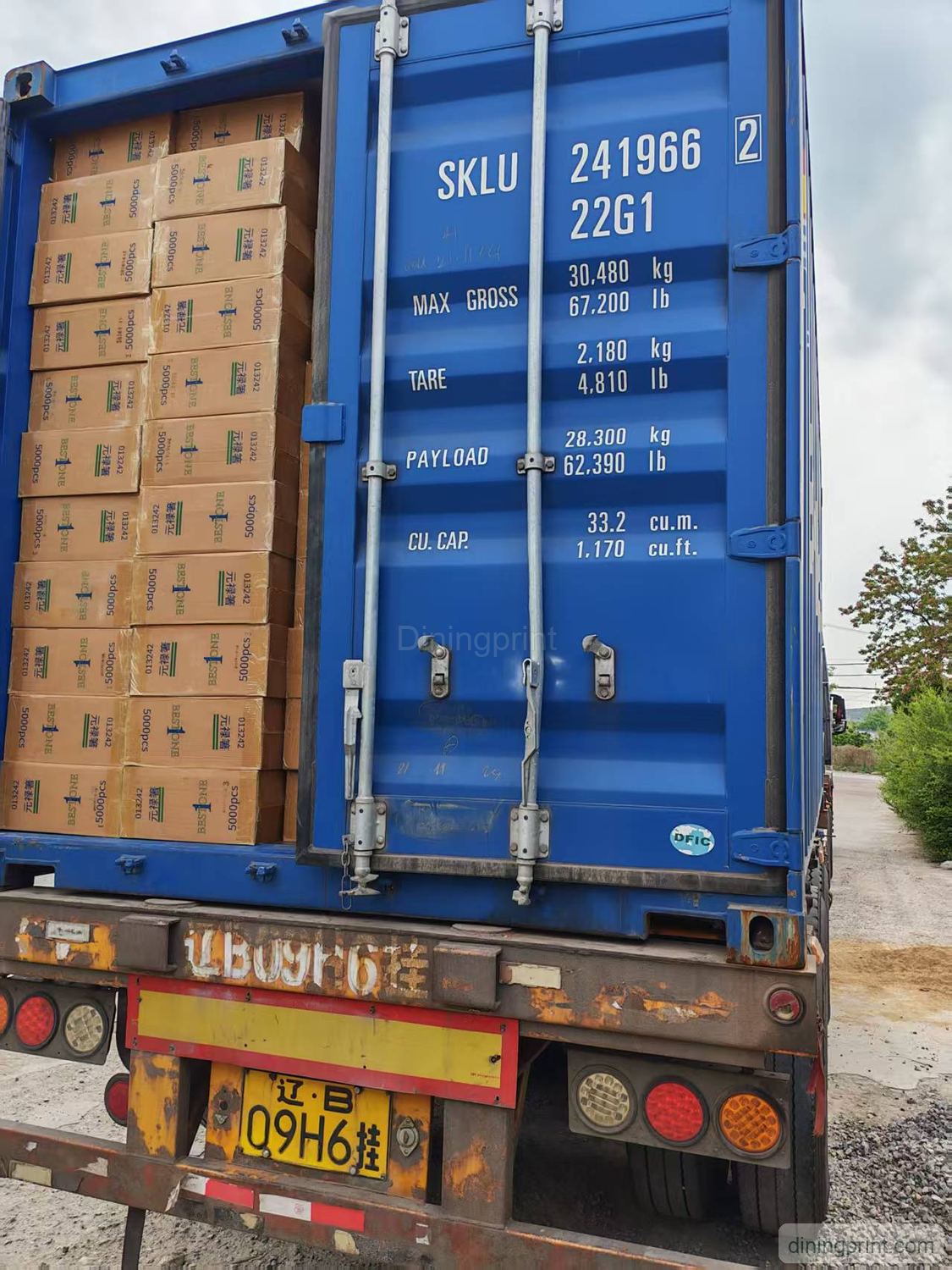
Factory proof: loading export cartons
What the freight step actually looks like at our end — export cartons for custom-printed disposable tableware being staged and loaded before they head to port.
The full timeline, step by step
- Artwork + quote (Day 0): send your logo (vector) and target quantity; the factory returns a quote and a digital proof.
- Pre-production sample (Day 3–10): a physical printed sample for sign-off. Skip it at your own risk — screen color and printed color diverge.
- Deposit (Day 10): typically 30% by T/T (bank wire); balance before shipment.
- Production (Day 10–40): 18–30 days for most custom-printed chopsticks, cutlery, and sleeves.
- Booking + freight (Day 40): the goods leave the factory for the port; sea transit is 18–35 days to most US/EU/AU ports, air 3–7 days.
- Customs clearance (on arrival): your broker files entry with the HS code and pays duty + import VAT/GST on your behalf.
- Delivery: trucking from port to your warehouse, 1–5 days.
The same artwork-to-carton workflow is covered product-side in our custom chopsticks guide; this post is the logistics half.
Incoterms 2020 — the four that matter for tableware
Incoterms define exactly where the supplier’s responsibility ends and yours begins. Four cover almost every disposable-tableware order:
| Incoterm | Supplier handles | You handle | Best for |
|---|---|---|---|
| EXW (Ex Works) | Goods ready at factory | Everything else — export, freight, customs, delivery | Buyers with a China agent |
| FOB (Free On Board) | Export clearance + loading onto the ship | Sea freight, import customs, delivery | Most experienced importers — lowest landed cost |
| CIF (Cost, Insurance, Freight) | FOB + sea freight + insurance to your port | Import customs + delivery | Buyers who want freight handled but keep customs control |
| DDP (Delivered Duty Paid) | Everything to your door, duty paid | Receive the goods | B2B buyers needing one landed-cost figure |
For a first order, DDP removes almost all complexity — the supplier (or their forwarder) handles freight and customs and quotes you one landed price. Once you ship regularly, switching to FOB with your own freight forwarder usually saves 5–15% on landed cost and gives you control over carrier and timing.
Duties, HS codes, and import tax
Disposable wooden and bamboo tableware is generally a low-duty category, but you still need the correct commodity code and you still owe destination import tax.
| Market | Typical duty on wooden/bamboo tableware | Plus |
|---|---|---|
| United States | Often duty-free or low under HTS 4419 (tableware/kitchenware of wood) | MPF + HMF fees; check current Section 301 status |
| European Union | Low MFN duty under CN 4419 | Import VAT at your country’s rate (recoverable if VAT-registered) |
| United Kingdom | Low UK Global Tariff under 4419 | Import VAT (recoverable if VAT-registered) |
| Australia | Often duty-free under tariff 4419 | 10% GST on the landed value |
HS code 4419 ("tableware and kitchenware, of wood") covers most chopsticks, cutlery, and serving items; paper sleeves and napkins fall under chapter 48. Confirm the exact subheading with your broker — an incorrect HS code is the most common cause of a customs hold and a reassessed duty bill. Duty and tax rules change; always verify current rates for your tariff line before you commit.
The wood-specific paperwork most first-timers miss
Because chopsticks and wooden cutlery are wood products, several countries require pest-control documentation that doesn’t apply to plastic or paper goods:
- Fumigation / heat-treatment certificate — proof the wood was treated against pests. Required by Australia (strict biosecurity), and often requested by the EU and US for raw wood. Finished, kiln-dried, food-grade chopsticks are usually low-risk, but the certificate prevents a quarantine hold.
- ISPM 15 stamp on wooden pallets — if your goods ship on solid-wood pallets, the pallets themselves must carry the ISPM 15 heat-treatment mark, or the whole container can be held.
- FSC chain-of-custody document — not a customs requirement, but EU and Australian retail buyers increasingly ask for it on arrival (see our certification stack guide).
A factory that exports wood tableware daily produces these without being asked. If your supplier hesitates on the fumigation certificate, that’s a signal they don’t ship much real volume.
How much fits in a container?
Disposable tableware is light and bulky, so most orders cube out (fill the volume) long before they hit the weight limit. Rough loading guides:
| Container | Usable volume | Approx. printed chopsticks (sleeved) |
|---|---|---|
| 20′ FCL | ~28 m³ | ~1.5–2 million pairs |
| 40′ HC FCL | ~68 m³ | ~4–5 million pairs |
| LCL (shared) | per m³ | Any smaller quantity — pay per cubic meter |
Below roughly 10–15 m³ it’s usually cheaper to ship LCL (less-than-container-load, consolidated with other shippers) than to pay for a full container. Above that, a full 20′ is more cost-efficient per unit. Your supplier or forwarder will tell you the break-even for your exact volume.
Payment terms and how to stay protected
The standard for established China factories is T/T (telegraphic transfer): 30% deposit, 70% balance before shipment against a copy of the bill of lading. Notes on staying protected:
- Avoid 100% upfront on a first order with a new supplier.
- Pay to a verified company account whose name matches supplier records — never a personal account.
- For larger first orders, a letter of credit or an escrow/Trade Assurance mechanism adds protection at some cost.
- Hold the balance until you’ve approved pre-shipment photos or a third-party inspection — cheap insurance against a bad batch leaving the country.
Sea vs air — when each makes sense
Sea is the default for disposable tableware: 18–35 days transit, lowest cost per unit, and the right choice for planned reorders. Air (3–7 days) costs roughly 3–5x sea per kilo and is reserved for samples or urgent bulk replenishment.
Where to next
If you want a single landed-cost number without managing any of this, request a quote and ask for a DDP price to your city — we’ll handle production, freight, customs paperwork, and the fumigation certificate, and quote you one delivered price.
If you’re still scoping the product, the custom chopsticks guide and the MOQ guide cover the production side; the certification guide covers the documents your market will expect on arrival.
About Diningprint
Diningprint is a B2B custom-printed disposable-tableware supplier shipping to restaurants, cafés, food brands, hotels, and event caterers worldwide. We coordinate export by sea and air under FOB, CIF, and DDP terms, prepare the relevant export document set including fumigation and FSC paperwork when the route requires it, and can quote a landed-price option to your door. See the catalogue, preview your logo at the customizer, or order the printed sample kit.
Duty rates, HS classifications, and import requirements in this post are typical 2026 ranges for general B2B guidance, not customs or legal advice. Verify current rates for your specific tariff line and destination with a licensed customs broker before importing.
Quick answers from buyers like you
How long does it take to import custom chopsticks from China?
Budget 45–75 days end to end by sea, or 25–40 by air. That breaks down as: 3–10 days for artwork and a pre-production sample, 18–30 days production after deposit, 18–35 days sea freight (or 3–7 days air) to your port, then customs clearance plus 1–5 days trucking to your warehouse. First orders run toward the longer end because of sampling; reorders are faster.
What's the difference between FOB, CIF, and DDP for importing tableware?
FOB (Free On Board): the supplier clears export and loads the goods onto the ship; you arrange and pay sea freight, import customs, and delivery — lowest landed cost once you have a freight forwarder. CIF (Cost, Insurance, Freight): the supplier adds sea freight and insurance to your port; you handle import customs and delivery. DDP (Delivered Duty Paid): the supplier handles everything to your door including duty — the lowest-friction option for first-time or small importers. Most first orders use DDP; experienced importers switch to FOB to save 5–15%.
What is the import duty on wooden chopsticks and disposable tableware?
Wooden and bamboo tableware (HS code 4419) is generally low-duty or duty-free into the US, EU, UK, and Australia, but you still owe destination import tax: import VAT in the EU/UK (recoverable if VAT-registered) and 10% GST in Australia. US imports add MPF/HMF fees and you should check the current Section 301 status. Duty rules change — confirm the current rate for your exact tariff line with a licensed customs broker before importing.
Do I need a fumigation certificate to import wooden chopsticks?
Often, yes. Because chopsticks and wooden cutlery are wood products, Australia (strict biosecurity) requires a fumigation or heat-treatment certificate, and the EU and US frequently request one for wood goods. Any wooden pallets must also carry the ISPM 15 heat-treatment stamp. Finished kiln-dried food-grade chopsticks are low pest-risk, but the certificate prevents a quarantine hold. A factory that exports wood tableware regularly provides it without being asked.
How many chopsticks fit in a shipping container?
Disposable tableware is light and bulky, so it cubes out before hitting weight limits. A 20′ container (~28 m³) holds roughly 1.5–2 million sleeved printed pairs; a 40′ high-cube (~68 m³) holds roughly 4–5 million. Below about 10–15 m³ it's usually cheaper to ship LCL (consolidated, paid per cubic meter); above that a full 20′ container is more cost-efficient per unit.
What are the standard payment terms when importing from a Chinese factory?
The standard is T/T (bank wire): 30% deposit, 70% balance before shipment against a copy of the bill of lading. Pay to a verified company account that matches supplier records, never a personal account, and avoid 100% upfront on a first order with a new supplier. For larger first orders a letter of credit or escrow/Trade Assurance adds protection. Hold the balance until you've approved pre-shipment photos or a third-party inspection.
Should I ship disposable tableware by sea or air?
Sea is the default — 18–35 days transit at the lowest cost per unit, right for any planned reorder. Air (3–7 days) costs roughly 3–5x sea per kilo and only makes sense for samples, urgent top-ups, or a launch batch you under-ordered. A common pattern is air-freighting a small first batch to hit a launch date while the bulk order follows by sea.
Can the factory handle freight and customs so I just receive the goods?
Yes — that's a DDP (Delivered Duty Paid) order. The supplier or their freight forwarder arranges production, sea or air freight, export and import customs clearance, duty payment, and delivery to your door, then quotes you one landed price. It's the lowest-friction option for first-time importers; the trade-off is slightly higher cost than arranging your own FOB freight once you have a forwarder.
Keep going on related sourcing topics.
Custom Printed & Engraved Chopsticks for Restaurants | Bulk Factory Pricing
Choose printed sleeves or engraving for restaurant chopsticks, with real MOQ, sample proofing, bulk pricing, and a factory-direct quote path.
Read article
FSC vs FDA vs BSCI vs BRC: The Certification Stack Every B2B Tableware Buyer Should Demand
FSC covers the paper, not the ink. FDA covers the product, not the factory. BSCI covers the workers, not the food safety. Here's what each certification on disposable tableware actually proves — and the stack you should demand by market.
Read article
Custom Chopstick MOQ Explained: How Much Should You Order for Your First Run?
Entry MOQ is 20,000 pairs. Below that, review a free material or printed sample, not a production run. You pay courier; any artwork plate or tooling setup is quoted separately.
Read article
The 4-Layer China Supply Chain for Disposable Tableware: What Importers Don't See
Most Western buyers think they're 1-2 hops from the factory. For Northern Chinese wood and bamboo disposables, the reality is usually four. Here's how the structure inflates wholesale prices 60-80% — and three questions that detect it in 30 seconds.
Read article
Biodegradable cutlery kits and custom tableware for event catering.
Custom wooden cutlery kits, branded chopsticks, and printed napkins for event catering, weddings, festivals, stadium foodservice, and corporate dinners. A 3-piece wooden kit (fork + spoon + knife + napkin in a custom sleeve) starts at a 20,000-kit production MOQ and is priced on request. Lead time is 25-30 days plus freight.
See guide
Branded takeout packaging for ghost kitchens.
Custom-printed disposable tableware for ghost kitchens, virtual brands, and delivery-first restaurant groups — branded chopstick sleeves, wooden cutlery kits, and printed paper napkins. Production starts at 20,000 kits for eligible branded configurations, with per-kit pricing on request. The packaging that arrives at the customer's door is your only brand surface — we make it count.
See guide
Custom printed chopsticks and sushi restaurant supplies for wholesale orders.
Start with the items every sushi customer actually touches: bamboo chopsticks, printed chopstick sleeves, napkins, sauce cups, paper bags, and simple takeaway boxes or trays when needed. The tableware does not need to be complicated; the goal is a clean sushi experience with one consistent brand impression.
See guide